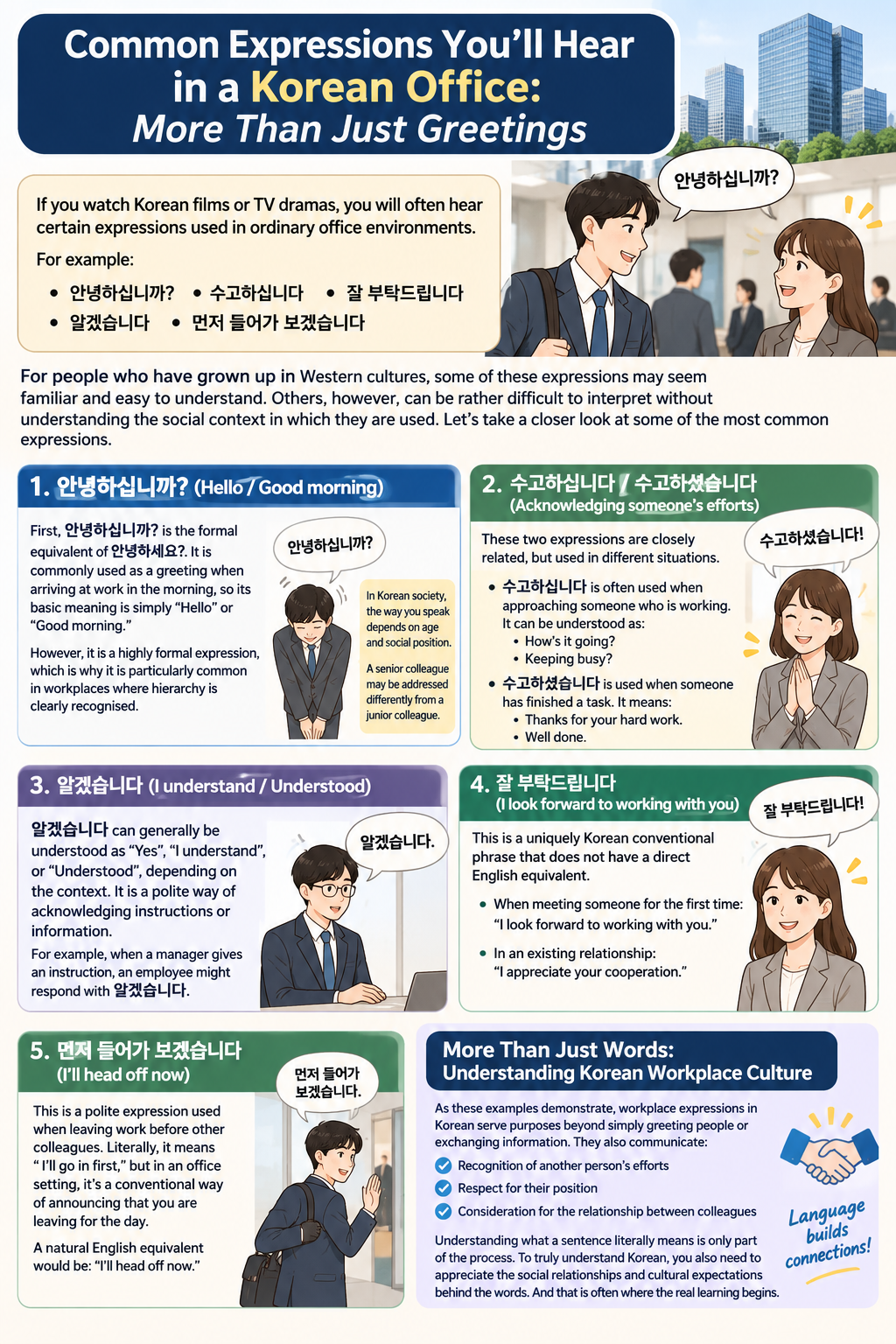
한국 영화나 드라마를 보면, 일반적인 사무실이 있는 직장 내에서 쓰는 전형적인 말들이 있다.
이를테면,
안녕하십니까?
수고하십니다.
잘 부탁 드립니다.
알겠습니다.
먼저 들어가보겠습니다.
서구적인 환경에서 살아온 사람들은 어느 부분은 이해가 되기도 하고, 어느 부분은 도대체 그 문맥을 이해하기가 어려울 수 있다.
일단, ‘안녕하십니까?‘는 ‘안녕하세요?’의 격식체이다. 그러니, 아침에 출근해서 하는 말이기도 해서, 그 뜻은 당연히 ‘안녕하세요?’이다.
그런데 ‘안녕하십니까?’는 말 그대로 격식체이기 때문에, 상하 관계가 분명한 직장 내에서 쓰이는 것이다. ‘상하관계’라고 하면 조금은 낯설지만, 한국 사회에서는 나이와 지위에 따라 쓰는 말투가 분명히 존재한다. 직장 내에서 직급이 높거나 낮으면 이를 상하관계로 인식한다.
‘수고하십니다’와 ‘수고하셨습니다’는 한 쌍이다. ‘수고하십니다’는 주로 대화를 시작할 때 쓰고, ‘수고하셨습니다’는 주로 대화를 끝마치거나 일을 다 끝냈을 때 한다. ‘수고하십니다’는 상대방이 일하고 있을 때 건네는 인사 또는 노고에 대한 인정으로 본다.
영어로는 ‘How's it going? / Keeping busy?’의 뜻으로 보면 좋다.
‘수고하셨습니다.’는 일이 끝난 뒤 상대방의 노력을 인정하는 표현이다.
영어로는 ‘Thanks for your hard work.’ 정도이다.
‘수고하다’의 사전적 의미는 ‘일을 하느라고 힘을 들이고 애를 쓰다’이다. 그러니 직장내에서 상대방이 일을 하고 있는 것에 대한 일종의 감사 표시라고 할 수 있다. 그런데, ‘수고하다’는 되도록 높은 직급의 상대가 낮은 직급의 상대에게 말을 하는 것이 좋다.
만약 자신의 직급이 낮은데 여러명의 상대에게 말을 하거나 높은 직급의 상대에게 말을 한다면 ‘고생하셨습니다’ 라고 말하거나, 차라이 ‘고맙습니다’나, ‘감사합니다’라고 감사의 표현을 하는 것이 좋다.
이런 말도 잘 들린다.
‘알겠습니다.’
이 말은 그대로 ‘yes’나 ‘I understand’정도로 받아들이면 좋다.
‘잘 부탁 드립니다.’ 라는 말도 있다. 이는 한국 특유의 관용적 표현이다.
처음 만날 때 ‘잘 부탁 드립니다’라고 하는 것은 ‘I look forward to working with you.’ 정도로 이해하면 좋겠다. 그리고 서로 알고 있는 상황에서는 ‘I appreciate your cooperation.’ 정도의 의미이다.
‘먼저 들어가 보겠습니다.’라는 말은 다른 사람보다 먼저 퇴근할 때 사용하는 정중한 표현이다.
영어로는 ‘I'll head off now.’ 의 뜻을 포함한다.
즉, 한국어의 직장 인사말은 단순한 인사 기능뿐 아니라 상대방의 노력에 대한 인정, 존중, 배려를 언어로 표현하는 기능도 가지고 있다.
Common Expressions You’ll Hear in a Korean Office: More Than Just Greetings
If you watch Korean films or TV dramas, you will often hear certain expressions used in ordinary office environments.
For example:
안녕하십니까?
수고하십니다.
잘 부탁드립니다.
알겠습니다.
먼저 들어가 보겠습니다.
For people who have grown up in Western cultures, some of these expressions may seem familiar and easy to understand. Others, however, can be rather difficult to interpret without understanding the social context in which they are used.
Let's take a closer look at some of the most common expressions.
1. 안녕하십니까? (Hello / Good morning)
First, 안녕하십니까? is the formal equivalent of 안녕하세요?. It is commonly used as a greeting when arriving at work in the morning, so its basic meaning is simply "Hello" or "Good morning".
However, 안녕하십니까 is a highly formal expression, which is why it is particularly common in workplaces where hierarchical relationships are clearly recognised.
The idea of a workplace hierarchy may seem somewhat unfamiliar to people from more egalitarian Western working environments. In Korean society, however, the way people speak to one another is strongly influenced by age and social position. Within an organisation, differences in job titles and seniority are also reflected in language.
In other words, the way you address a senior colleague may be quite different from the way you speak to someone in a more junior position.
2. 수고하십니다 / 수고하셨습니다 (Acknowledging someone's efforts)
These two expressions are closely related, but they are generally used in different situations.
수고하십니다 is often used when approaching someone who is working. It can function as a greeting or as a way of acknowledging the effort they are putting into their work.
Depending on the context, it can be understood as something like:
How's it going?
Keeping busy?
수고하셨습니다, on the other hand, is generally used when someone has finished a task or when a conversation or work-related interaction is coming to an end.
It acknowledges the other person's effort and can be translated as:
Thanks for your hard work.
Well done.
The dictionary meaning of 수고하다 is to make an effort and work hard, often involving considerable time or energy.
Therefore, these expressions can be understood as a way of recognising and appreciating the work someone is doing.
There is, however, an important social nuance to remember.
Traditionally, 수고하다 is more appropriately used by someone in a senior position when speaking to a junior colleague. If you are in a more junior position and addressing several colleagues or someone in a higher position, it may be safer to say 고생하셨습니다, or simply use 고맙습니다 or 감사합니다 to express your appreciation.
This distinction is particularly useful for understanding workplace interactions in Korean dramas.
3. 알겠습니다 (I understand / Understood)
This is another expression you will hear frequently in Korean offices.
알겠습니다 can generally be understood as "Yes", "I understand", or "Understood", depending on the context.
It is a polite and formal way of acknowledging instructions, information or a request.
For example, when a manager gives an employee an instruction, the employee might respond with 알겠습니다 to indicate that they have understood and will follow through.
It is more than simply saying "yes". It often conveys an understanding of what is expected.
4. 잘 부탁드립니다 (I look forward to working with you)
This is a particularly interesting expression because it is a uniquely Korean conventional phrase that does not have a direct English equivalent.
When meeting someone for the first time, 잘 부탁드립니다 can be understood as:
"I look forward to working with you."
It expresses the hope that the relationship will develop positively and that both parties will work well together.
In an existing working relationship, the same expression can carry a slightly different meaning. Depending on the situation, it may be closer to:
"I appreciate your cooperation."
or
"Thank you for your continued support."
The exact meaning depends heavily on the relationship between the speakers and the context in which it is used.
5. 먼저 들어가 보겠습니다 (I'll head off now)
This is a polite expression used when leaving work before other colleagues.
Literally, it means something like "I'll go in first", but in an office setting, it is a conventional way of announcing that you are leaving for the day.
A natural English equivalent would be:
"I'll head off now."
It is not simply an announcement that you are leaving. It also reflects consideration for the colleagues who are still working.
More Than Just Words: Understanding Korean Workplace Culture
As these examples demonstrate, workplace expressions in Korean serve purposes beyond simply greeting people or exchanging information.
They also communicate recognition of another person's efforts, respect for their position, and consideration for the relationship between colleagues.
This is one of the interesting aspects of learning Korean. Understanding what a sentence literally means is only part of the process. To understand what people really mean, you also need to understand the social relationships and cultural expectations behind the words.
And that is often where the real learning begins.