

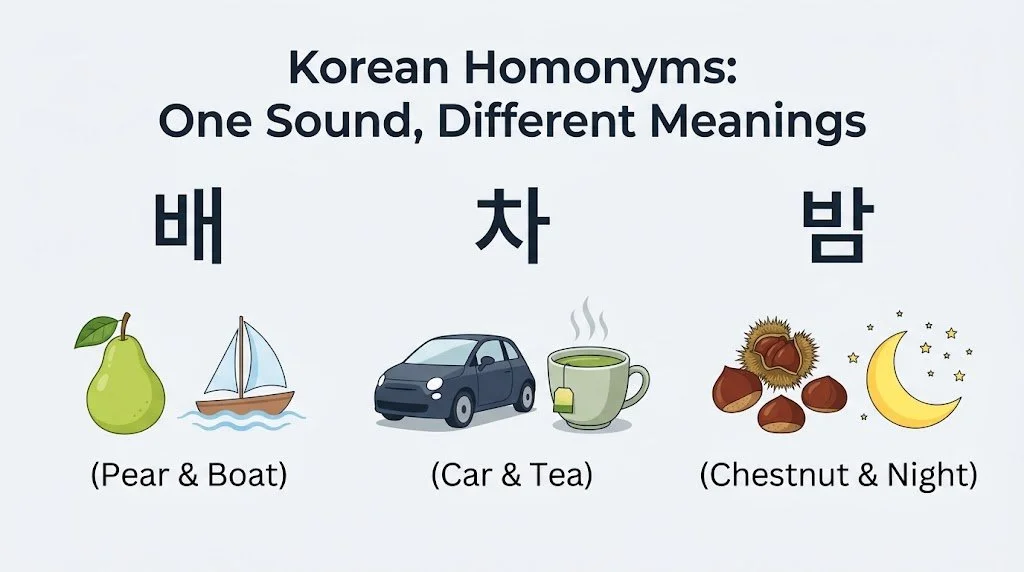
동형어 몇 개 Korean Homonyms: One Sound, Multiple Meanings - The Power of Context in Korean
Why can one Korean word have completely different meanings? Discover how context helps you understand Korean words like 배 (stomach, boat, or times), 차 (tea or car), and 밤 (chestnut or night).
한국어를 배울 때 여러 힘든 점 중의 하나는 소리는 같은데 뜻이 전혀 다른 말들이 존재한다는 점이다.
다음의 문장들을 살펴보자.
-나는 ‘배’가 아프다. → I have a stomachache.
-나는 ‘배’를 탔다. → I took a boat.
-4는 2의 두 ‘배’이다. → Four is twice as much as two.
어떤 뜻인지 해석이 가능한가? 각 문장마다 ‘배’라는 글자가 들어있다. 그러나 각각 의미가 다르다.
첫번째는 사람의 신체부위인 배이고,
두번째는 탈것의 하나인 배이고,
세번째는 곱절을 뜻하는 배이다.
-나는 어제 친구와 ‘차’를 마셨다. → I drank tea with my friend yesterday.
-나는 어제 ‘차’를 운전했다. → I drove a car yesterday.
이 두 문장의 해석은 어떤가? 아마도 ‘마셨다’와 ‘갔다’라는 동사를 고려하여 ‘차’의 해석이 가능할 것이다.
‘마셨다’는 ‘drink’의 과거형이므로 첫번째 문장의 ‘차’는 ‘tea’이다.
‘운전했다’는 ‘drive’의 과거형이므로 두번째 문장의 ‘차’는 ‘car’이다.
다음의 문장들을 살펴보고 뜻을 짐작해보자.
-나는 고구마보다 ‘밤’이 맛있다. → I prefer chestnuts to sweet potatoes.
-해가 지고 ‘밤’이 되었다. → After the sun set, it became night.
이 두개의 문장들은 좀더 생각을 요구한다.
첫번째 문장의 경우 ‘고구마보다’라는 말을 해석할 수 있으면 좋다. ‘고구마보다’는 ‘than sweet potatoes’라는 뜻이다. 그러니 ‘밤’은 고구마와 비슷한 맛을 성질을 가진 식품임을 짐작할 수 있다. 여기서 ‘밤’은chestnut이다.
두번째 문장은 ‘해가 지고’의 의미를 생각하면 좀 더 이해가 가능하다. ‘해가 지고’는 after the sun set'이라는 뜻이다. 그럼 세상은 어떻게 되겠는가? 깜깜한 밤night가 될 것이다.
한국어는 이렇듯 같은 소리를 가졌지만 다른 뜻을 가진 말들이 많기에 좀더 문맥들을 살펴서 짐작할 수 있어야 한다.
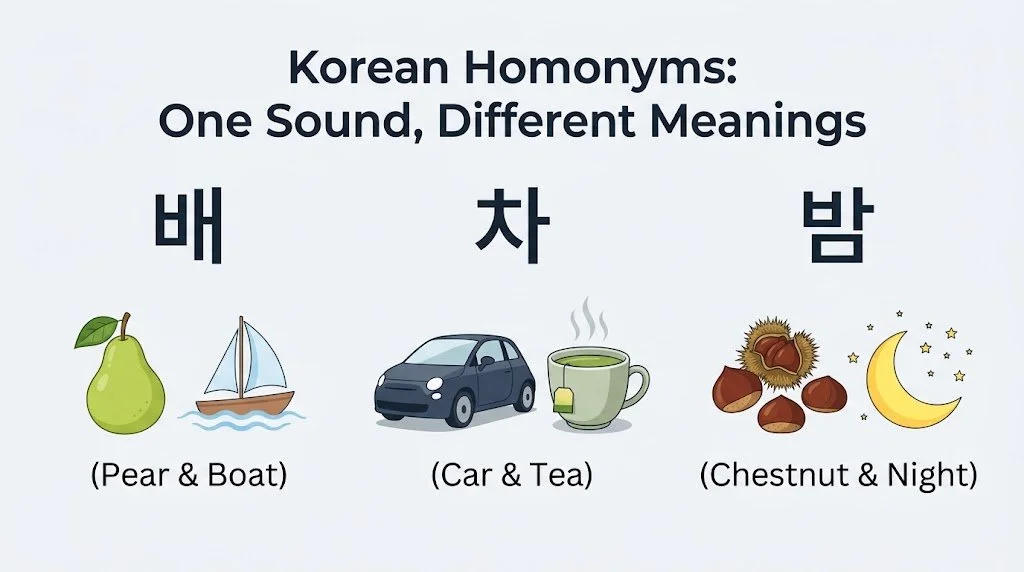
One of the challenges of learning Korean is that there are words that sound the same but have completely different meanings.
Let’s look at the following sentences.
나는 ‘배’가 아프다. → I have a stomachache.
나는 ‘배’를 탔다. → I took a boat.
4는 2의 두 ‘배’이다. → Four is twice as much as two.
Can you work out what each sentence means?
Each sentence contains the word ‘배’ (bae), but the word has a different meaning in each sentence.
In the first sentence, ‘배’ means stomach, a part of the human body.
In the second, ‘배’ means boat, a type of transportation.
In the third, ‘배’ means times or a multiple of, referring to multiplication.
Now, let’s look at another pair of sentences.
나는 어제 친구와 ‘차’를 마셨다. → I drank tea with my friend yesterday.
나는 어제 ‘차’를 운전했다. → I drove a car yesterday.
What about these two sentences? You can probably work out the meaning of ‘차(cha)’ by paying attention to the verbs.
The verb ‘마셨다’ means ‘drank’, the past tense of ‘drink’. Therefore, ‘차’ in the first sentence means tea.
The verb ‘운전했다’ means ‘drove’, the past tense of ‘drive’. Therefore, ‘차’ in the second sentence means car.
Now, let’s look at the following sentences and see if you can guess what they mean.
나는 고구마보다 ‘밤’이 맛있다. → I prefer chestnuts to sweet potatoes.
해가 지고 ‘밤’이 되었다. → After the sun set, it became night.
These two sentences require a little more thought.
In the first sentence, it helps if you understand the expression ‘고구마보다’, which means ‘than sweet potatoes’. From this, you can infer that ‘밤(bam)’ refers to a food that can be compared with sweet potatoes in terms of taste. In this context, ‘밤’ means chestnut.
The second sentence becomes easier to understand when you consider the meaning of ‘해가 지고’, which means ‘after the sun set’. What happens after the sun sets? The world becomes dark, and it becomes night.
As these examples show, Korean has many words that share the same pronunciation but have different meanings. To understand them correctly, learners need to pay close attention to the context and use the clues provided by the surrounding words and expressions to work out the intended meaning.