

한국어 입문자에서 중급 단계로 갈 때 Moving from a Beginner to an Intermediate Level of Korean
Moving from Hangul to intermediate Korean introduces the complex world of grammar and social context.
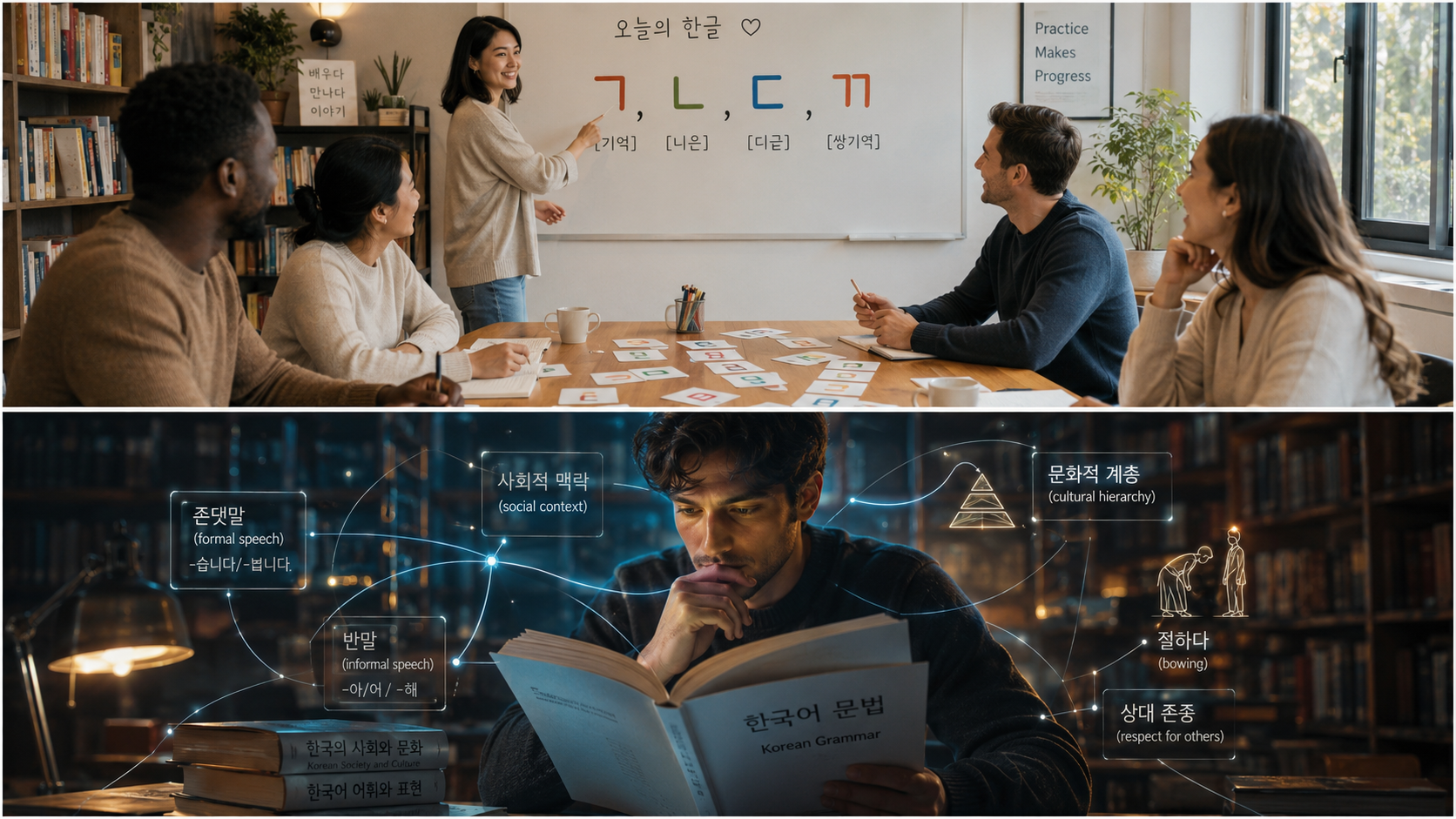
한국어의 처음은 한글을 익히는 것이다. 가끔은 거센소리를 어떻게 발음할 것인가에 대해 굉장히 헷갈리는 경우가 많다. 가끔은 발음할 때의 소리와 표기법에 따른 소리가 상충할 때가 있다. 분명 나의 귀에는 나에게 익숙한 나의 모국어 발음과 비슷한 소리로 들려서 그렇게 발음하는데 가르치는 사람은 그게 아니라고 정정해준다. 쌍자음은 또 어떤가. 일반적 자음 ㄱ과 쌍자음 ㄲ은 때로 똑같이 들린다. 교사는 계속적으로 정정을 해준다. 그러면서 한국어 특유의 자음과 모음이 있음을 깨닫는다.
하지만 이 단계에서 대부분의 학습자들은 비교적 어려움없이 한글의 모음과 자음을 익힌다. 그 과정에서 대부분의 학습자들은 깨닫는다. 한글은 굉장히 기계적으로 익힐 수 있는 언어이구나. 한국에 가서 한글 간판이나 음식 메뉴 등을 읽을 때 꽤 유용하겠는 걸. 가끔은 거센소리를 어떻게 발음할 것인가에 대해 굉장히 헷갈리는 경우가 많다.
문제는 이 지점부터이다. 모든 단모음, 겹모음, 단자음, 겹자음까지 익히고, 거센소리까지 익히고 나면 이제부터 어디로 가야하나 생각이 드는 것이다. 한국어의 문법은 굉장히 고립되어 있고 독창적인 방식이면서 동시에 유연하기 때문에 쉬운듯 어렵고, 어려우면서 쉬운 느낌을 준다. 심지어 내가 한국의 중고등학교에서 한국어를 가르칠 때에도 대부분의 학생들은 그들이 비록 한국어를 쓰는 원어민임에도 어려움을 호소한다. 일단 문법을 배워야한다는 사실을 납득을 못한다. 내가 원어민으로서 한국어를 쓰는 것이 자연스러운데 굳이 뭐하러 문법을 배워야하나 하는 것이다. 둘째로 문법을 배움에 있어서 그 용어들이 어렵다. 문법을 설명하는 용어들이 한자어같은데도 묘하게 말이 이상하게 번역이 된 말들이 많다. 이는 오래전에 일본어 문법 교본을 참고로 한국어문법을 만들었을 때부터 예정된 일이다. 지금은 많이 한국어로 순화가 된 말들이 많지만, 아무래도 학교에서 문법을 배울 때에는 일본어 문법 체계를 예시로 삼아서 만들었기에 용어들이 그대로 쓰이기도 하고 안 그런 경우도 있다. 문법은 말을 자연스럽게 하기 위한 도구인데, 이를 위해 어려운 말들을 갖다 붙이니 학습자는 힘들기 마련이다.
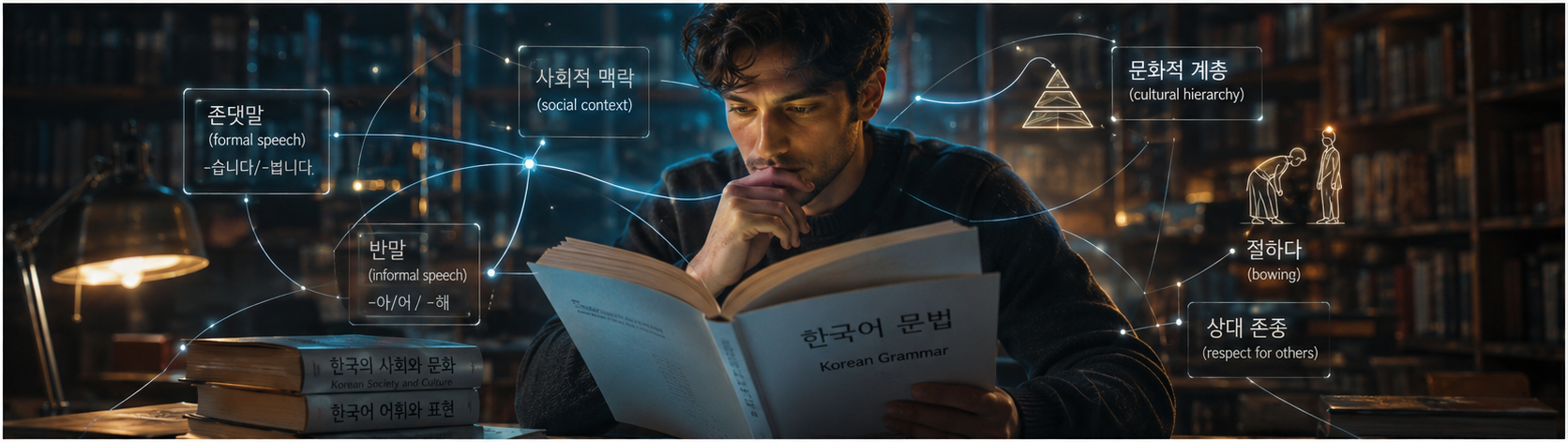
아동을 위한 문법책을 들여다보면, 마치 언어학 전공자의 책처럼, 놀랍게도 음운론부터 형태론 및 통사론으로 이어지는 구조를 가지고 있다. 즉, 한글의 모든 음절을 익히고 나서 바로 짧은 문장을 통해 형태론을 배운다. 여기서 바로 초급 단계에서 중급 단계, 아울러 고급으로 가는 내용들이 담겨있다. 한국어는 통사론을 통해 사회적 맥락을 배워야하고 이를 위해 형태론에서 다뤄지는 갖가지 양상들을 알아야 한다. 좀더 미세적으로 분류된 사회적 맥락을 수학 공식처럼 나누었다고 해야할까.
그래서 한국어를 가르치는 사람의 고민이 깊어진다. 단순히 글을 읽을 줄 안다고 우리는 그 언어를 안다고 할 수 없다. 한국어는 굉장히 오래된 언어이고, 사회적인 언어이기도 하다.

Moving from a Beginner to an Intermediate Level of Korean
The very first step in learning Korean is mastering Hangul. At this initial stage, learners often find themselves quite confused about how to pronounce aspirated consonants. There is frequently a friction between the actual pronunciation and the written spelling. To a learner's ears, a certain sound might closely resemble a familiar phonetic feature from their native language, leading them to pronounce it that way—only for the teacher to step in and correct them.
Double consonants pose another hurdle. The plain consonant 'ㄱ' (g/k) and the tense/double consonant 'ㄲ' (kk) can sound identical to an untrained ear. As the teacher continuously corrects these nuances, learners gradually realize that Korean possesses its own unique system of consonants and vowels.
Despite these subtle challenges, most learners master the basic vowels and consonants of Hangul relatively easily. Through this process, they come to a realization: Hangul is a highly logical and systematic script that can be learned almost mechanically. It quickly becomes a practical tool, giving them the confidence to read street signs or food menus when visiting Korea.
The Real Challenge Begins
The true obstacle, however, emerges right after this point. Once a learner has memorized all the simple vowels, diphthongs, plain consonants, double consonants, and aspirated consonants, they often hit a wall, wondering, "Where do I go from here?" Korean grammar can feel strangely paradoxical—it seems easy yet difficult, and difficult yet easy, precisely because it is deeply nuanced, unique, and highly flexible. Even when I was teaching Korean in middle and high schools in Korea, native-speaking students would frequently complain about its complexity.
First, they struggle to justify the need for grammar rules. As native speakers who use the language effortlessly every day, they wonder why they must study its formal structure.
Second, the grammatical terminology itself is notoriously difficult. Many grammatical terms sound like traditional Hanja (Sino-Korean characters), yet they often feel like awkwardly translated words.
This linguistic hurdle was set in motion long ago when modern Korean grammar frameworks were heavily influenced by Japanese grammatical textbooks. While a great deal of the terminology has since been purified into native Korean phrasing, the foundational school grammar system still echoes that older structure. Grammar is ultimately a tool designed to make speech flow naturally, but when learners are bombarded with abstract, archaic terminology, connecting the rules to real-world usage becomes a daunting task.
Decoding the Social Context
If you look into a Korean grammar textbook written for children, it surprisingly mirrors the rigorous structure of a linguistics major's textbooks—sequentially guiding the reader through phonology, morphology, and syntax. In other words, immediately after mastering the syllables of Hangul, children dive straight into morphology through short sentences.
This is precisely where the bridge from beginner to intermediate—and eventually advanced—proficiency lies. To truly master Korean, one must grasp social context through syntax, which in turn requires a deep understanding of the diverse linguistic facets managed within morphology. The subtle boundaries of Korean social context are almost divided with the precision of a mathematical formula.
Consequently, the dilemma for Korean language educators deepens. I cannot simply claim that someone "knows" a language just because they can read its script. Korean is an ancient, deeply rooted language—and above all, it is a profoundly social one.