

자음 첨가에 대해서 Consonant Insertion in Korean: Why Korean Sounds Different from What You See
When learning Korean, you may notice that native speakers sometimes pronounce words quite differently from the way they appear in writing. In this post, we explore how consonant assimilation and consonant insertion work through the example of 십육 (16), and why these natural pronunciation changes can be challenging for Korean learners. We also look at why listening and imitation are just as important as understanding the rules.
우리는 각자의 언어를 쓰는 인간이다. 나는 한국인이니 당연히 한국어를 쓴다. 한국어로 의사소통을 하면서 문법이나 음성학적 현상을 깊이 고민하지는 않는다. 물론 나는 좀 고민하는 편이다.
어찌 되었든,
다른 나라의 언어를 배울 때는 마치 말을 처음 배우는 어린아이처럼 된다. 당연한 이야기이다. 하지만 다시 한번 설명을 붙이자면, 언어학적 현상에 대해 백지 상태로 돌아가는 경우가 무수히 많다. 언어는 나라별로 지역별로 제각기 다르지만, 말을 할 때에 음운론적이고 음성학적인 현상은 대체로 비슷하게 발생한다. 하지만 보통의 학생들은 이에 대해서 의문을 제기한다. 즉, 원어민들이 그들의 언어로 말을 할 때에, 갑자기 내가 배우던 언어가 아닌 다른 소리로 들리거나, 다른 소리로 말을 한다는 것이다.
다음 숫자를 읽어보자.
16
‘십육’이라고 읽는가?
만약 당신이 [sip-yuk]이라고 읽는다면 그건 굉장히 힘든 일이다.
그것은 ‘십’과 ‘육’ 사이에 엄청난 개입이 일어나기 때문이다.
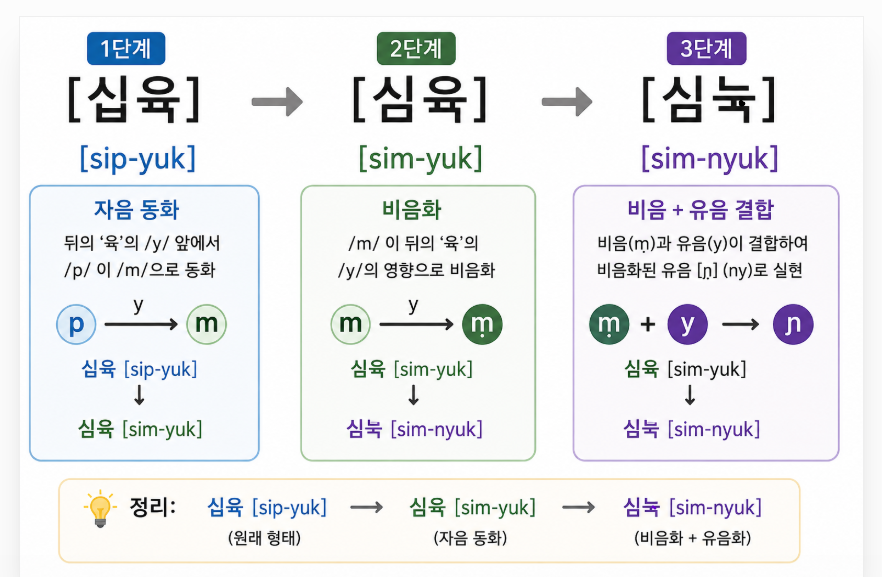
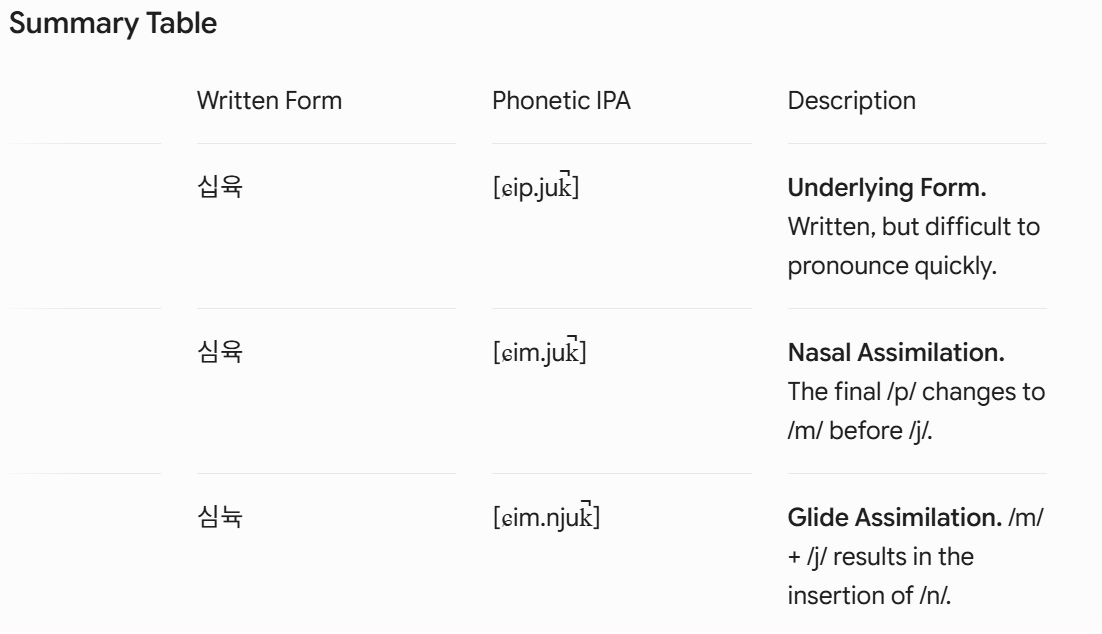
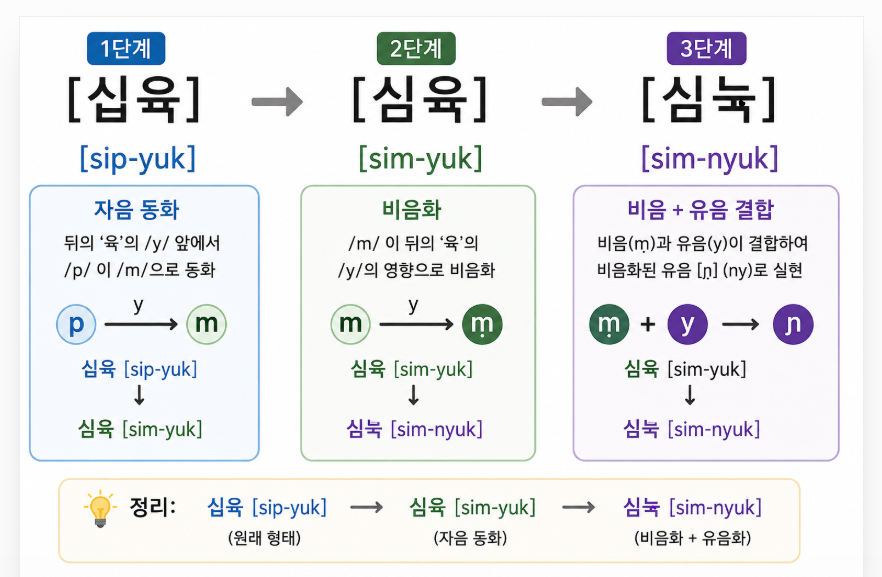
'십'은 ‘육’에 의해, 정확히는 ‘ㅇ’에 의해 ‘심’으로 바뀐다. 이를 “자음동화'“라고 한다. 파열음인 ‘ㅂ’이 ‘ㅇ’에 의해 비음화되는 현상이다.
십육 → 심육
그렇다면 ‘심육’이 되는가? 그건 또 아니다. ‘육’을 제대로 발음하기 어려운 까닭이다.
이때 자음의 개입이 일어난다. 이른바 “자음첨가”이다. 그럼 어떤 자음이 첨가가 될까?
‘육’의 ‘ㅇ’은 ‘심’ 뒤에서 정확히 발음하기 어렵다. 그런데 ‘ㄴ’을 첨가하면?
다음을 읽어보자.
[심뉵]
즉 [sim-nyuk]으로 읽게 되었을 때 당신의 발음기관들이 비로소 편안하게 소리를 낼 것이다.
[십육] → [심육] → [심뉵]
이런 것들을 하나하나 다 외워야 하는가, 라고 물으면 그렇지 않다. 이것은 굉장히 자연스러운 현상이기 때문이다. 하지만 한국어를 배우는 입장에서는 절대로 자연스럽게 이런 일들이 일어나지 않는다.
그러므로 외국어를 배우는 것은 머리로만 이해하고 말하려고 할 때 좀 어려운 점들이 있다. 그래서 어린아이들처럼 무작정 들은 것을 따라 하든가 읽는 연습을 많이 해야 할 것이다.
We are all human beings who speak our own languages. I am Korean, so naturally, I speak Korean. When communicating in Korean, I do not usually stop to think deeply about grammar or phonetic phenomena. Of course, I tend to think about these things a little more than most people do!
In any case, when we learn another language, we become a little like children learning to speak for the first time. This may sound obvious, but let me explain what I mean.
There are countless moments when we have to return to a kind of blank slate when it comes to linguistic phenomena. Languages are different from country to country and from region to region, but many phonological and phonetic processes occur naturally when people speak.
Most native speakers do these things without even thinking about them.
However, language learners often have questions about what they hear. When native speakers speak their language naturally, suddenly the language can sound completely different from what we have been learning. Sometimes, it even sounds as though they are saying different words.
Let's look at a simple example in Korean.
How do you pronounce 16?
The number 16 is written:
십육
Do you read it as sip-yuk?
If you try to pronounce it exactly as it is written, it can actually be quite difficult.
Why?
Because a lot is happening between 십 and 육.
First, 십 changes because of the following 육, more precisely because of the initial ㅇ sound in 육.
The final ㅂ in 십 is a stop consonant, but before the nasal sound ㅇ, it becomes nasalized.
So:
십육 → 심육
This is an example of consonant assimilation (자음동화).
But do we simply pronounce it as 심육?
Not quite.
There is another phonological process that makes the pronunciation easier.
The initial ㅇ in 육 is difficult to pronounce directly after 심. So Korean adds another consonant between the two syllables.
This is called consonant insertion (자음 첨가).
But which consonant is inserted?
A ㄴ is inserted:
심 + ㄴ + 육 → 심뉵
So the natural pronunciation becomes:
[심뉵]
In romanisation, you could think of this as approximately:
[sim-nyuk]
At this point, the speech organs can move more naturally and comfortably from one sound to the next.
So we can see the pronunciation changing step by step:
십육 → 심육 → 심뉵
This may look complicated when we write it down, but for a native Korean speaker, it happens naturally and automatically.
Do you have to memorise all of this?
You might ask, “Do I really have to memorise every single one of these changes?”
The answer is: not necessarily.
These changes are natural phonological processes that occur as we speak. Native speakers do not consciously calculate each sound or think, “Now I need to change this consonant.”
But for someone learning Korean as a foreign language, these changes do not happen naturally at first.
This is one reason why learning a foreign language can sometimes be difficult if we try to understand everything intellectually before we speak.
We need to train our ears and our speech organs as well as our brains.
That is why, just like children learning their first language, it is important to listen to native speakers repeatedly and imitate what we hear. Reading aloud and practising pronunciation again and again can also help.
Sometimes, you simply have to hear it, imitate it, and say it many times before it starts to feel natural.
That is not a failure to understand the grammar.
It is simply how language works.