


지금 추워요? 더워요? Is It Cold or Hot Right Now?
Why is it 더워요, not 덥어요? As Sydney welcomes summer under a canopy of purple jacaranda blossoms, discover how Korea and Australia experience opposite seasons and learn one of the most common Korean irregular conjugation patterns: ㅂ irregular verbs.
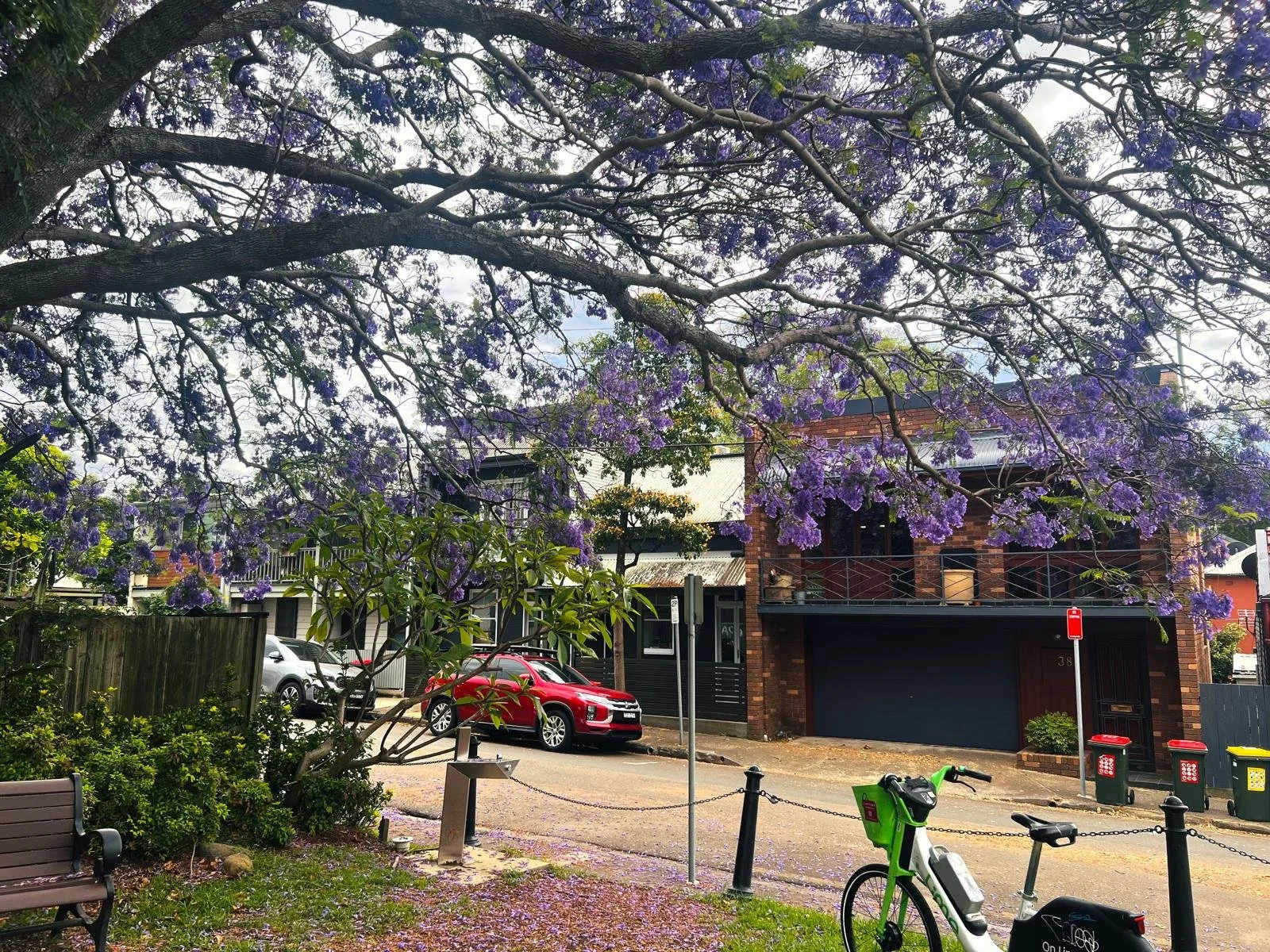
나는 지금 호주 시드니에서 살고 있다.
호주는 남반구에 위치하고 있다. 그러므로, 북반구에 위치한 한국과는 반대로 계절이 흐른다.
바야흐로, 한국은 겨울에 들어간다.
반대로 호주는 여름으로 들어간다.
한국에서 벚꽃이 피고 신록이 흐드러진 후에 여름이 찾아오듯이,
호주는 보라색의 자카란다가 피고 여름이 찾아온다. 그래서 지금 나라 전체가 보라색이다. 이제는 꽃이 지고 있는 때라서 나무 위 뿐만 아니라 바닥도 떨어진 꽃들도 인해 보라색이다.
오늘은 시드니 날씨는 32도로 매우 더운 날씨이다.
금요일부터 덥기 시작하더니 월요일인 오늘도 꽤나 더운 날씨이다.
덥다.
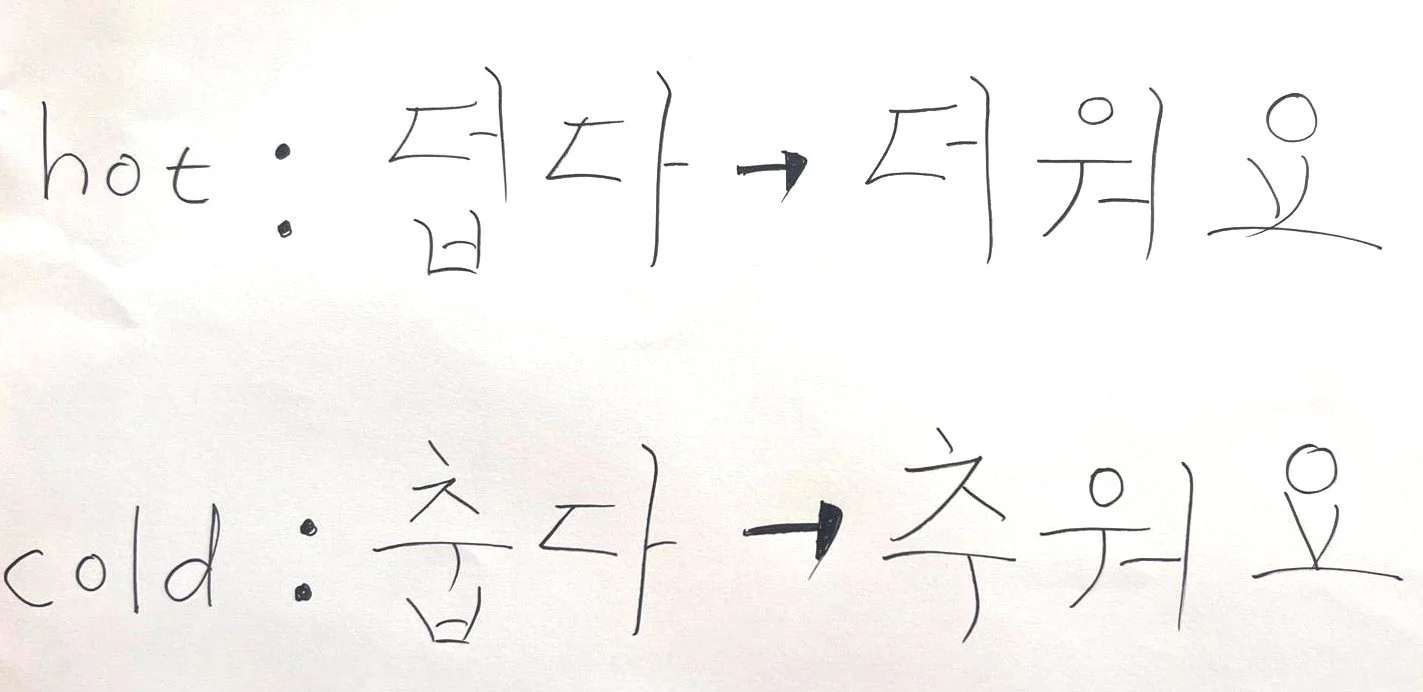
‘덥다’는 기본형이다. 이것을 해요체로 바꾸면 ‘더워요’이다.
즉,
덥다 → 더워요
의 양태를 띤다.
‘덥어요’라고 ‘어요’ 종결어미를 바로 붙여버리면 잘못된 용언의 활용이 된다. 왜냐하면,
‘덥-’의 받침 ‘ㅂ’이 ‘우/ㅜ’로 바뀌기 때문이다. 이것을 ‘ㅂ불규칙’이라고 하는데,
많은 학습자들이 한국어를 배울 때 처음 겪는 불규칙 현상이라서 꽤 낯설어한다.
‘ㅂ’의 위치를 잘 생각해보면 ‘우’와 매우 흡사하다.
따라서 이 ‘ㅂ불규칙’은 아주 자연스러운 현상으로 이해하면 된다.
그래서 지금 호주는 ‘더워요.’
한국은 어떤가?
한국은 ‘춥다’. 해요체로 바꾸면?
‘추워요.’이다.
다들 겨울 준비, 여름 준비를 잘 하고 있기를 바란다.
Is It Cold or Hot Right Now?
I currently live in Sydney, Australia.
Australia is located in the Southern Hemisphere, which means its seasons are opposite to those in South Korea, located in the Northern Hemisphere.
As winter approaches in Korea, Australia is heading into summer.
Just as summer arrives in Korea after the cherry blossoms bloom and the trees become lush with fresh green leaves, summer in Australia arrives after the jacarandas burst into bloom with their beautiful purple flowers.
That is why the whole country seems to be covered in purple at this time of year. The jacaranda season is now coming to an end, and the flowers are beginning to fall. Not only are the trees covered in purple, but the ground beneath them is also carpeted with fallen blossoms.
Today, the temperature in Sydney is 32°C, making it a very hot day.
The weather started getting hot on Friday, and even today, Monday, it is still quite hot.
덥다 (to be hot).
This is the dictionary form of the adjective. How do we change it into the haeyo-che (polite conversational) form?
It becomes 더워요 (It's hot).
In other words:
덥다 → 더워요
If we simply attach the ending -어요 to 덥다 and say 덥어요, it would be an incorrect conjugation.
Why?
Because the final consonant, ㅂ, in the stem 덥- changes to 우 (u) when certain vowel endings are added. This is known as the ㅂ irregular conjugation (ㅂ 불규칙 활용).
Many Korean learners encounter this as one of their first irregular conjugation patterns, so it can feel quite unfamiliar at first.
However, if you look closely at the shape and position of ㅂ, you might notice that it has some visual similarities to 우. Thinking about this connection can help you remember the change more naturally.
So, right now, in Australia, we say:
더워요! (It's hot!)
What about Korea?
한국은 춥다. (Korea is cold.)
And how do we change 춥다 into the haeyo-che form?
추워요! (It's cold!)
I hope everyone is getting ready for the season ahead, whether that means preparing for winter or getting ready for summer.
Stay warm, or stay cool, wherever you are!

‘책이 있어요’는 왜 ‘책을 있어요’가 아닌가 Why Do We Say ‘책이 있어요’ Instead of ‘책을 있어요’?
An excerpt from a lesson on the Korean grammatical structure of 있다, and why “I have a book” is expressed as 저는 책이 있어요, rather than 저는 책을 있어요.
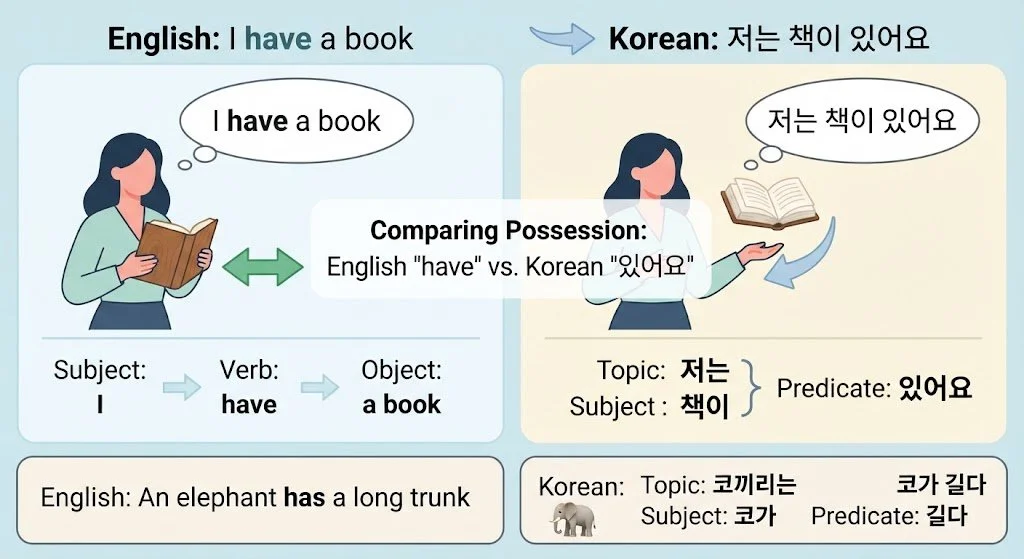
“I have a book”을 해석해보자.
저는 책이 있어요.
저는 책을 있어요.
무엇이 맞는가?
답은 첫번째이다. ‘저는 책이 있어요’이다.
영어의 ‘a book’이 동사 ‘have’ 앞에 놓인 목적어이기 때문에, 한국어에서도 ‘책’을 목적어로 생각하기 쉽다. 그런데 어째서 목적격 조사 ‘을,를’이 아닌 주격조사 ‘이, 가’를 붙이는가?
그것은 ‘있어요’가 기본적으로 ‘have’가 아니기 때문이다.
‘있어요’의 원형은 ‘있다’이다. 영어로 하면 ‘exist’에 가깝다. 그러므로 ‘저는 책이 있어요’가 되며, 영어로 자연스럽게 바꾸면 “I have a book”이다. 그러나 한국어의 구조를 이해하기 위해서 직역을 하면 ‘As for me, there is a book’으로 이해하는 것이 좋겠다.
보통 한국어 학습자들이 ‘있어요’를 배울 때, 두 가지 타입으로 받아들인다. 하나는 ‘존재’이며, 다른 하나는 ‘소유’이다. 이는 영어가 백그라운드인 학습자의 배움의 편의에 의해서 나온 분류이다. ‘있어요’의 기본형인 ‘있다’의 기본적인 의미는 ‘존재’이며, 문맥에 따라 소유·위치·상태 등의 의미로 확장되어 나타난다.
그렇다면 ‘저는’은 주어가 아닌가?
즉 “저는 책이 있어요”는,
현대 국어 문법에서는 ‘저는’을 주어라고 보기 보다는,
화제 - 저는
주어 - 책이
라고 본다.
학자에 따라서는 이를 이중 주어문으로 해석을 한다. 즉,
주어 1 - 저는
주어 2 - 책이
라고 해석이 가능하다. ‘저는’과 ‘책이’를 각각 주어로 보는 것이다.
이러한 분석에서는 첫 번째 주어가 두 번째 주어가 나타내는 대상을 소유하거나 그와 관련된 전체를 나타내는 역할을 한다.
다음의 예시를 보자.
“코끼리는 코가 길다”
여기서 ‘길다’와 직접적 서술어의 관계를 맺는 것은 무엇일까?
‘코끼리는’인가? ‘코가’인가?
두번째 성인 ‘코가’가 실질적인 주어이지만, 그 코를 가진 것은 ‘코끼리’이기 때문에 섣불리 말하기가 어렵다. (이에 대해서는 학자들마다 의견이 분분하다.)
역시 현대 한국어 문법을 따라서,
화제 - 코끼리는
주어 - 코가
길다 - 서술어
로 보는 것이 좋겠다.
즉, 영어의 ‘have’는 결국 한국어에서의 ‘있다’와 서로 완전히 다른 문법적 구조를 가진다.
한국어의 모든 문장 성분이 영어의 그것과 정확히 일치하면 한국어 배우기가 훨씬 수월하겠지만, 이렇게 다른 의미 해석이 나오는 경우가 훨씬 더 많다.
Let’s take a look at the sentence, “I have a book.”
저는 책이 있어요.
저는 책을 있어요.
Which one is correct?
The answer is the first one: 저는 책이 있어요.
Because “a book” is the object that comes after the verb “have” in English, it is easy to think of 책 (book) as an object in Korean as well. But why do we use the subject marker 이/가 instead of the object marker 을/를?
The reason is that 있어요 is not basically the Korean equivalent of “have.”
The dictionary form of 있어요 is 있다, which is closer in meaning to the English verb “exist.” Therefore, we say 저는 책이 있어요. If we translate it naturally into English, it becomes “I have a book.” However, in order to understand the Korean sentence structure, it can be helpful to think of a literal translation as:
“As for me, there is a book.”
When Korean learners study 있어요, they often understand it as having two different types of meaning. One is existence, and the other is possession. This distinction is largely made for the convenience of learners whose linguistic background is English.
The basic meaning of 있다, the dictionary form of 있어요, is existence, and depending on the context, it can extend to meanings such as possession, location, and state.
Then what about 저는? Isn’t it the subject?
In modern Korean grammar, rather than treating 저는 as the subject, it is generally analyzed as the topic, while 책이 is the subject:
Topic — 저는
Subject — 책이
Depending on the scholar or grammatical analysis, however, this can also be interpreted as a double-subject construction. In that analysis:
Subject 1 — 저는
Subject 2 — 책이
In other words, both 저는 and 책이 can be analyzed as subjects.
Under this analysis, the first subject represents the whole or the entity that possesses or is associated with what the second subject refers to.
Let’s look at another example:
코끼리는 코가 길다.
“An elephant has a long trunk.”
Here, which element has a direct predicative relationship with 길다 (is long)?
Is it 코끼리는 (as for the elephant)?
Or is it 코가 (the trunk)?
The second element, 코가, is the one that has the direct predicative relationship with 길다, and therefore can be considered the actual subject. However, it is the elephant that possesses the trunk, so the relationship between the two elements cannot be explained quite so simply. (Scholars have different views on how exactly to analyze this structure.)
Again, following the general analysis used in modern Korean grammar, it is useful to understand the sentence as:
Topic — 코끼리는
Subject — 코가
Predicate — 길다
In other words, English “have” and Korean “있다” ultimately express possession through very different grammatical structures.
If every sentence element in Korean corresponded exactly to its counterpart in English, learning Korean would certainly be much easier. But there are many more cases in which the two languages organize and interpret meaning differently in this way.