“감사합니다” or “캄사합니다”? Why Korean ㄱ Sounds Like /k/ to English Speakers

감사합니다.
캄사합니다.
무엇이 맞을까?
결론부터 말하자면, 첫번째 ‘감사합니다’가 맞다.
이 글을 읽으면서 당연히 ‘ㄱ’이 평음이니 ‘감사합니다’가 맞지, 그밖에 다른 게 어떻게 있을 수가 있겠어? 하며 생각이 들 수 있다. 그러나 한국어를 처음 접한 사람들에게는 그 소리가 그렇게 들리지 않는다. 그들의 ‘감사합니다’는 ‘캄사합니다’이다.
이는 필연적으로 생겨나는 현상이다. ‘ㄱ’은 평음이지만, 영어 사용자에게는 '/g/가 아닌 /k/로 들리기 때문이다.
하지만 한국인이 듣는 입장으로는,
감사합니다
캄사합니다
이 둘의 차이는 극명하다. 두번째의 경우는 굉장히 어색하게 느껴지기 때문이다. 영어권 사용자들에게는 '기식’을 사용하는 방식이 극명한 차이가 있다. 예를 들어 ‘key’라는 단어의 경우, 강한 /키/라고 발음해야 한다. 따라서 영어권 학습자에게 한국어의 ㄱ은 영어의 ‘k’에 더 가깝게 느껴진다.
그러면 어떻게 ‘감사합니다’를 소리를 내야 할까.
되도록 ‘gamsahamnida’로 내도록 노력해야 한다. 첫소리의 ‘ㄱ’은 필연적으로 공기가 아주 조금 들어가기에 완벽한 ‘g’소리로 수렴하기 어렵다는 것을 이해해야 한다.
감사합니다.
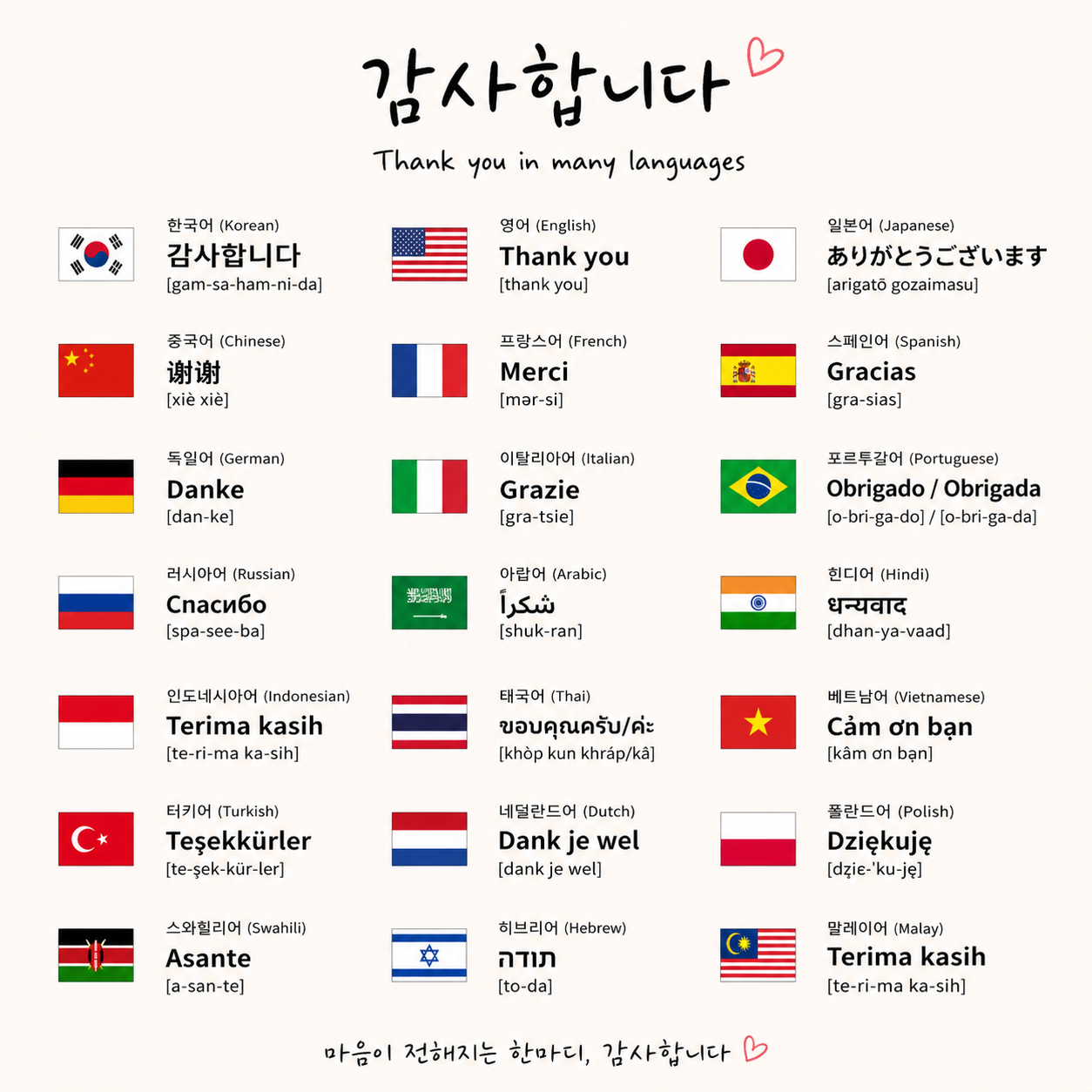
Which one is correct?
감사합니다
캄사합니다
The answer is the first one: 감사합니다.
As a Korean speaker, you might read this and think, “Of course 감사합니다 is correct. ㄱ is a voiced sound, so what else could it be?”
But for people who are new to Korean, the sound can be quite different. What they hear—and often what they produce—is closer to “캄사합니다.”
This is a natural and almost inevitable phenomenon.
The Korean consonant ㄱ is a plain (lax) consonant, but it does not correspond exactly to either the English /g/ or /k/. To English speakers, however, the sound at the beginning of a Korean word can often sound closer to /k/.
For Korean speakers, the difference is quite noticeable:
감사합니다
캄사합니다
The second one sounds distinctly unnatural.
One reason is the difference in how Korean and English use aspiration—the small burst of air that can accompany a consonant.
Consider the English word “key.” The /k/ in key is strongly aspirated, meaning that a noticeable puff of air follows the consonant. Because English speakers are accustomed to this strong aspiration, the Korean ㄱ may sound more like their English /k/ than their /g/.
So, how should an English-speaking learner pronounce 감사합니다?
A useful starting point is to aim for:
gamsahamnida
Try to produce the initial ㄱ without the strong burst of air that you would use for the /k/ in key. At the same time, don't try too hard to produce a perfect English /g/, because the Korean ㄱ is not exactly the same sound either.
The goal is to find the Korean sound in between what English speakers may think of as /g/ and /k/—a sound that is much less strongly aspirated than the /k/ in key.
So, when you say 감사합니다, think less about producing a perfect “g” and more about reducing the puff of air.
감사합니다 — not 캄사합니다.
This small difference in aspiration is one of the first pronunciation challenges English-speaking learners encounter when learning Korean.