

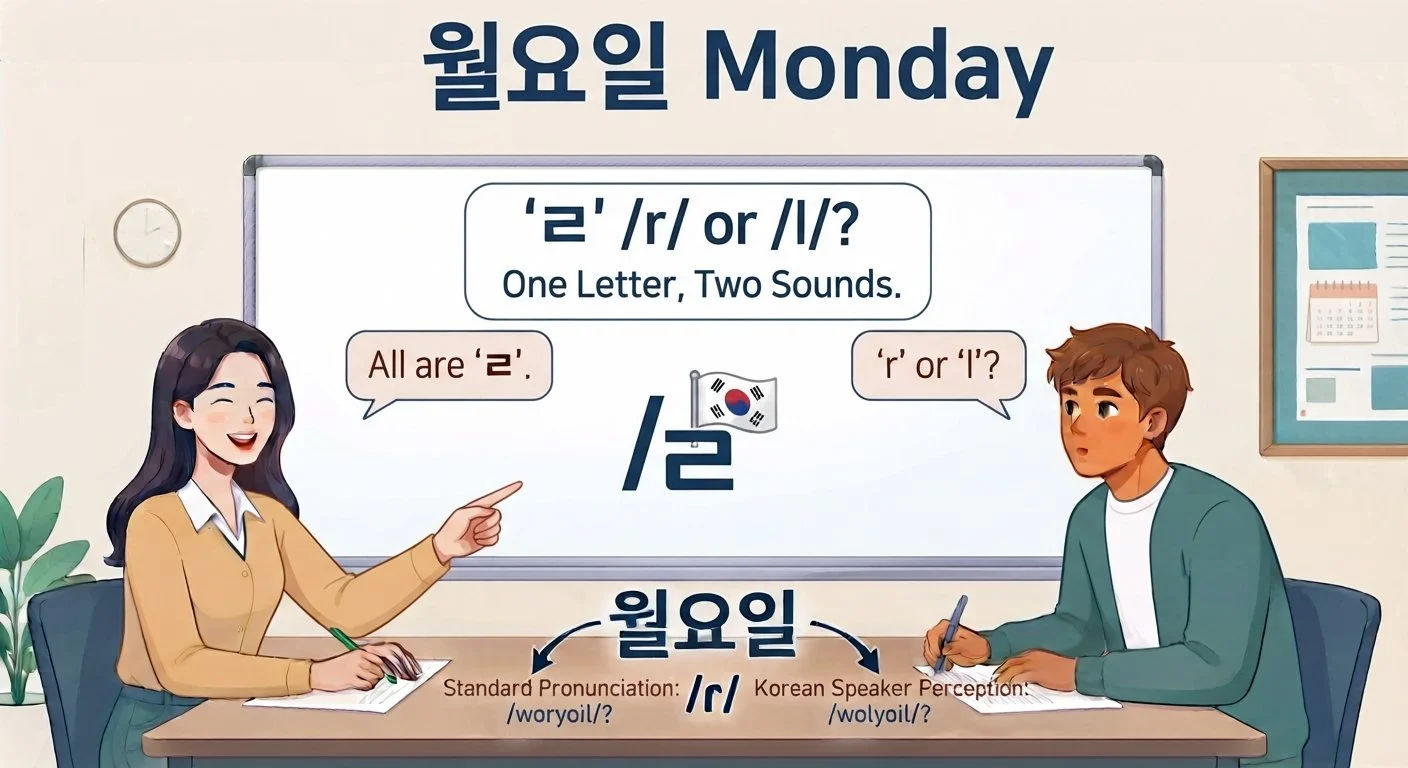
월요일의 발음 What Is the Standard Pronunciation of “월요일”?
Why does 월요일 sound like woryoil to some learners of Korean but wolyoil to Korean speakers? Learn how Korean ㄹ works as a single phoneme with different allophones, including [l] and [ɾ], and why English-speaking learners may perceive it differently because English distinguishes /r/ and /l/. This guide explains Korean ㄹ pronunciation and the phonological challenges learners of Korean may experience.
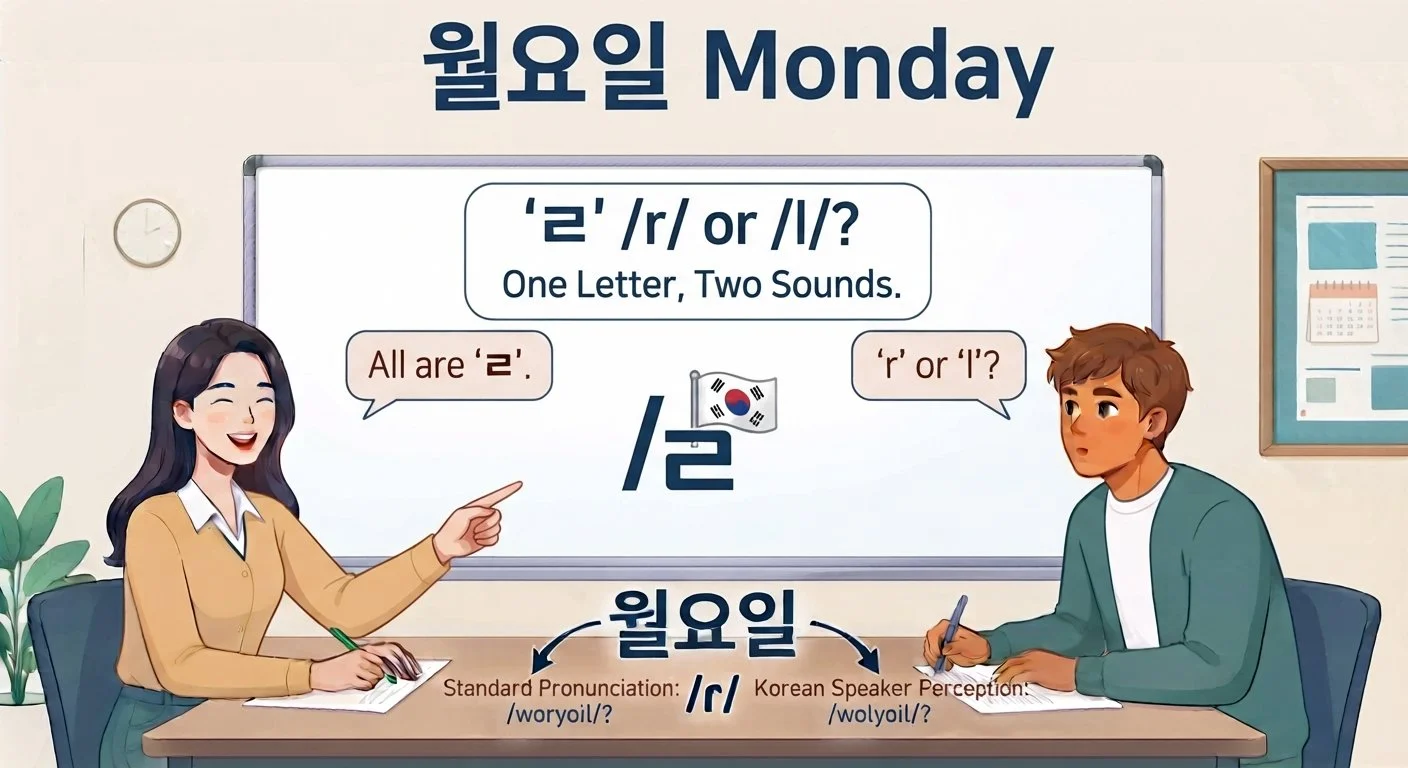
‘월요일’의 표준발음은 무엇일까?
한국인은 당연히 /워료일/이라고 생각한다. 그런데 같은 /워료일/인데 왜 한국어 학습자들에게는 어렵게 느껴질까?
다음을 발음해보자.
일요일
팔월
칠월
십일월
공통적으로 모음 사이에 ‘ㄹ’이 들어가 있다.
한국인들에게 ‘ㄹ’은 모두 같은 소리로 인식이 되어 있다. 하지만 영어를 쓰거나 그와 비슷한 언어를 쓰는 서구권의 학습자들은 다 같은 ‘ㄹ’로 인식되지 않는다.
다음을 발음해보자.
라면
한라산
모두 ‘ㄹ’이 들어가 있다.
첫번째는 /라면/이고 두번째는 /할라산/이다. 이 두 단어에서 ‘ㄹ’은 영어 알파벳의 ‘L’에 가깝다. 물론 영어를 배경으로 하는 학습자들은 ‘라면’이 ‘ramen’이라는 걸 알아서 ‘r’로 발음하지만 한국인들에게는 그저 같은 ‘ㄹ’일 뿐이다.
다시 ‘월요일’로 돌아가서,
영어를 배경으로 하는 학습자들의 고충은, 그들이 유음(liquid)을 한가지만 가지고 있지 않다는 점이다. ‘r’과 ‘ㅣ’ 이라는 음운적 대립 분포를 가지고 있기에 ‘라면’과 ‘월요일’의 ‘ㄹ’은 전혀 다른 소리로 들린다.
여기서 중요한 것은 실제 한국어 발음이 두 가지라는 뜻은 아니라는 것이다.
한국어의 ㄹ은 하나의 음운 /ㄹ/이다.
이 음운은 환경에 따라 [l]이나 [ɾ] 등의 이음(allophone)으로 실현된다.
영어의 /r/과 /l/은 서로 다른 음운이고, 영어권 학습자는 이 두 음운의 틀을 통해 한국어 ㄹ을 지각하려는 경향이 있다.
그래서 같은 한국어 ㄹ을 한국인은 하나의 /ㄹ/로, 영어권 학습자는 r에 가까운 소리로 지각할 수 있다.
즉, 한국인에게 ‘월요일’은 /wolyoil/으로 느껴지고, 서구권 학습자들에게는 /woryoil/로 느껴진다.
그럼에도 변명을 하자면, 모음 사이에서 자음은 유음화가 일어난다. ‘ㄹ’은 유음화가 일어나도 한국인에게는 단 하나의 ‘ㄹ’을 갖고 있기에 차이를 못느낀다. 하지만 서구권 학습자들에게는 그들의 모국어의 음운 체계가 갖는 특수성, 즉 ‘r’과 ‘l’이라는 범주화 때문에 다른 소리로 느껴지는 것인다. 그러므로 당신이 하는 그 발음이 맞다.
‘월요일’은 /woryoil/이다.
What Is the Standard Pronunciation of “월요일”?
What is the standard pronunciation of 월요일?
Korean speakers naturally think of it as /woryoil/. But if it is the same /woryoil/, why does it feel difficult to learners of Korean?
Let’s try pronouncing the following words:
일요일
팔월
칠월
십일월
In all of these words, ㄹ occurs between vowels.
To Korean speakers, all of these instances of ㄹ are perceived as the same sound. However, for learners of Korean who speak English or a similar Western language, they may not all be perceived as the same ㄹ.
Now let’s try the following:
라면
한라산
Both words contain ㄹ.
The first is /라면/, while the second is /할라산/. In these two words, ㄹ is close to the English sound represented by the letter L.
Of course, learners with an English-language background may pronounce 라면 with an r because they know that 라면 corresponds to ramen. But to Korean speakers, it is simply the same Korean ㄹ.
Let’s return to 월요일.
The difficulty for learners with an English-language background is that they do not have just one liquid in their sound system. English has a phonemic contrast between /r/ and /l/, so the ㄹ in 라면 and the ㄹ in 월요일 can sound completely different to them.
What is important here is that this does not mean that Korean actually has two different pronunciations of ㄹ as separate phonemes.
Korean ㄹ is one phoneme, /ㄹ/.
This phoneme is realized as different allophones, such as [l] and [ɾ], depending on its phonological environment.
English /r/ and /l/ are separate phonemes, and learners from an English-speaking background tend to perceive Korean ㄹ through the framework of these two phonemic categories.
Therefore, the same Korean ㄹ may be perceived as a single /ㄹ/ by Korean speakers, while learners from an English-speaking background may perceive it as a sound closer to r in some environments.
In other words, to a Korean speaker, 월요일 feels like /wolyoil/, whereas to learners from a Western-language background, it may feel more like /woryoil/.
Even so, if we want to offer an explanation, consonants between vowels may undergo a change in their phonetic realization. Korean ㄹ, however, is still perceived by Korean speakers as a single ㄹ, so they do not notice the difference.
For learners from a Western-language background, on the other hand, the phonological system of their native language has its own particular characteristics. Because they categorize sounds into distinct /r/ and /l/ phonemes, the same Korean ㄹ can be perceived as a different sound depending on its phonetic realization.
So, the pronunciation you are using is correct.
“월요일” is /woryoil/.

“감사합니다” or “캄사합니다”? Why Korean ㄱ Sounds Like /k/ to English Speakers
“감사합니다” or “캄사합니다”?
Which one sounds correct to you?
For Korean speakers, the answer is obvious: 감사합니다.
But for English-speaking learners of Korean, the same word may sound more like “캄사합니다.”
Why?

감사합니다.
캄사합니다.
무엇이 맞을까?
결론부터 말하자면, 첫번째 ‘감사합니다’가 맞다.
이 글을 읽으면서 당연히 ‘ㄱ’이 평음이니 ‘감사합니다’가 맞지, 그밖에 다른 게 어떻게 있을 수가 있겠어? 하며 생각이 들 수 있다. 그러나 한국어를 처음 접한 사람들에게는 그 소리가 그렇게 들리지 않는다. 그들의 ‘감사합니다’는 ‘캄사합니다’이다.
이는 필연적으로 생겨나는 현상이다. ‘ㄱ’은 평음이지만, 영어 사용자에게는 '/g/가 아닌 /k/로 들리기 때문이다.
하지만 한국인이 듣는 입장으로는,
감사합니다
캄사합니다
이 둘의 차이는 극명하다. 두번째의 경우는 굉장히 어색하게 느껴지기 때문이다. 영어권 사용자들에게는 '기식’을 사용하는 방식이 극명한 차이가 있다. 예를 들어 ‘key’라는 단어의 경우, 강한 /키/라고 발음해야 한다. 따라서 영어권 학습자에게 한국어의 ㄱ은 영어의 ‘k’에 더 가깝게 느껴진다.
그러면 어떻게 ‘감사합니다’를 소리를 내야 할까.
되도록 ‘gamsahamnida’로 내도록 노력해야 한다. 첫소리의 ‘ㄱ’은 필연적으로 공기가 아주 조금 들어가기에 완벽한 ‘g’소리로 수렴하기 어렵다는 것을 이해해야 한다.
감사합니다.
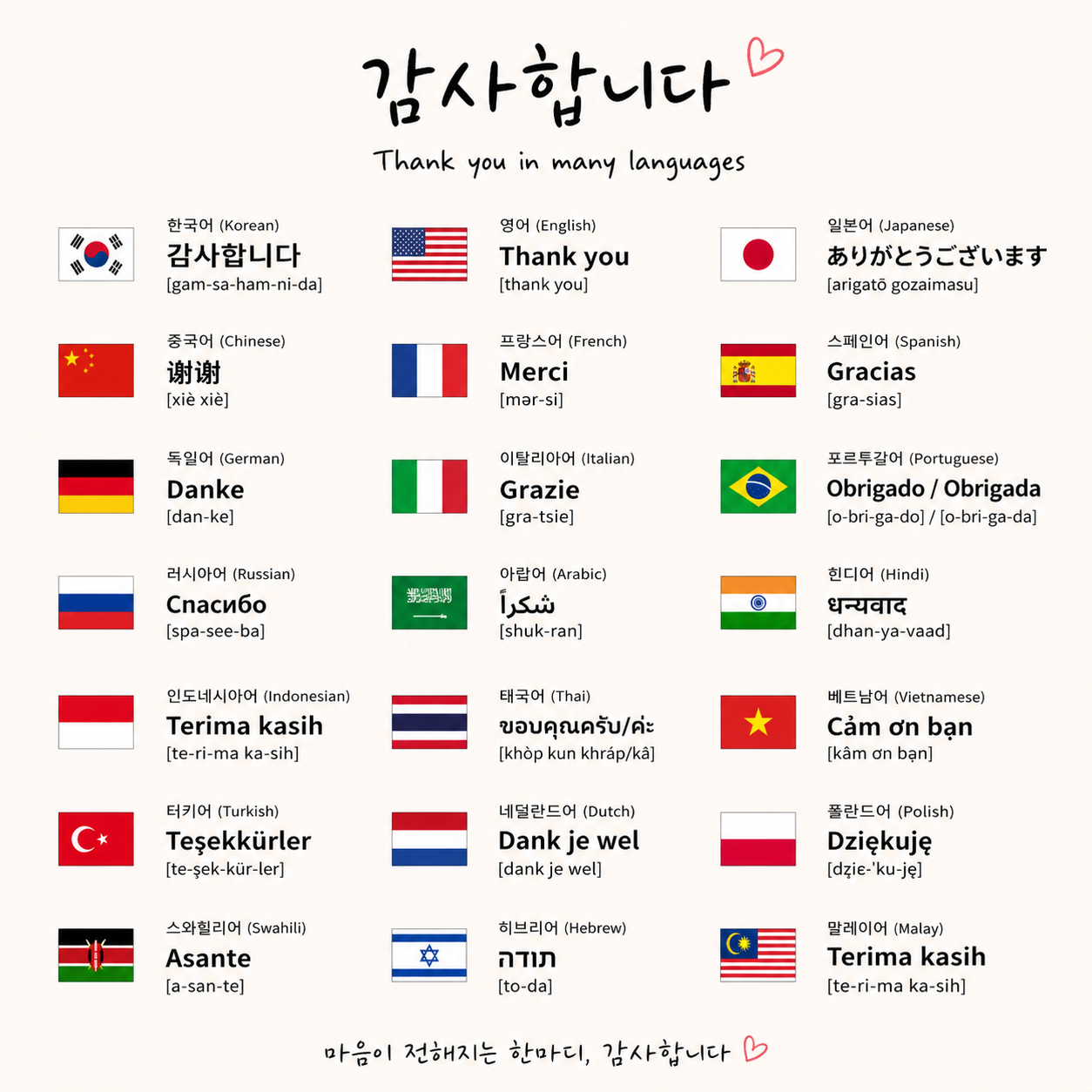
Which one is correct?
감사합니다
캄사합니다
The answer is the first one: 감사합니다.
As a Korean speaker, you might read this and think, “Of course 감사합니다 is correct. ㄱ is a voiced sound, so what else could it be?”
But for people who are new to Korean, the sound can be quite different. What they hear—and often what they produce—is closer to “캄사합니다.”
This is a natural and almost inevitable phenomenon.
The Korean consonant ㄱ is a plain (lax) consonant, but it does not correspond exactly to either the English /g/ or /k/. To English speakers, however, the sound at the beginning of a Korean word can often sound closer to /k/.
For Korean speakers, the difference is quite noticeable:
감사합니다
캄사합니다
The second one sounds distinctly unnatural.
One reason is the difference in how Korean and English use aspiration—the small burst of air that can accompany a consonant.
Consider the English word “key.” The /k/ in key is strongly aspirated, meaning that a noticeable puff of air follows the consonant. Because English speakers are accustomed to this strong aspiration, the Korean ㄱ may sound more like their English /k/ than their /g/.
So, how should an English-speaking learner pronounce 감사합니다?
A useful starting point is to aim for:
gamsahamnida
Try to produce the initial ㄱ without the strong burst of air that you would use for the /k/ in key. At the same time, don't try too hard to produce a perfect English /g/, because the Korean ㄱ is not exactly the same sound either.
The goal is to find the Korean sound in between what English speakers may think of as /g/ and /k/—a sound that is much less strongly aspirated than the /k/ in key.
So, when you say 감사합니다, think less about producing a perfect “g” and more about reducing the puff of air.
감사합니다 — not 캄사합니다.
This small difference in aspiration is one of the first pronunciation challenges English-speaking learners encounter when learning Korean.