

한국어의 숫자와 단위 Korean Numbers and Counting Units
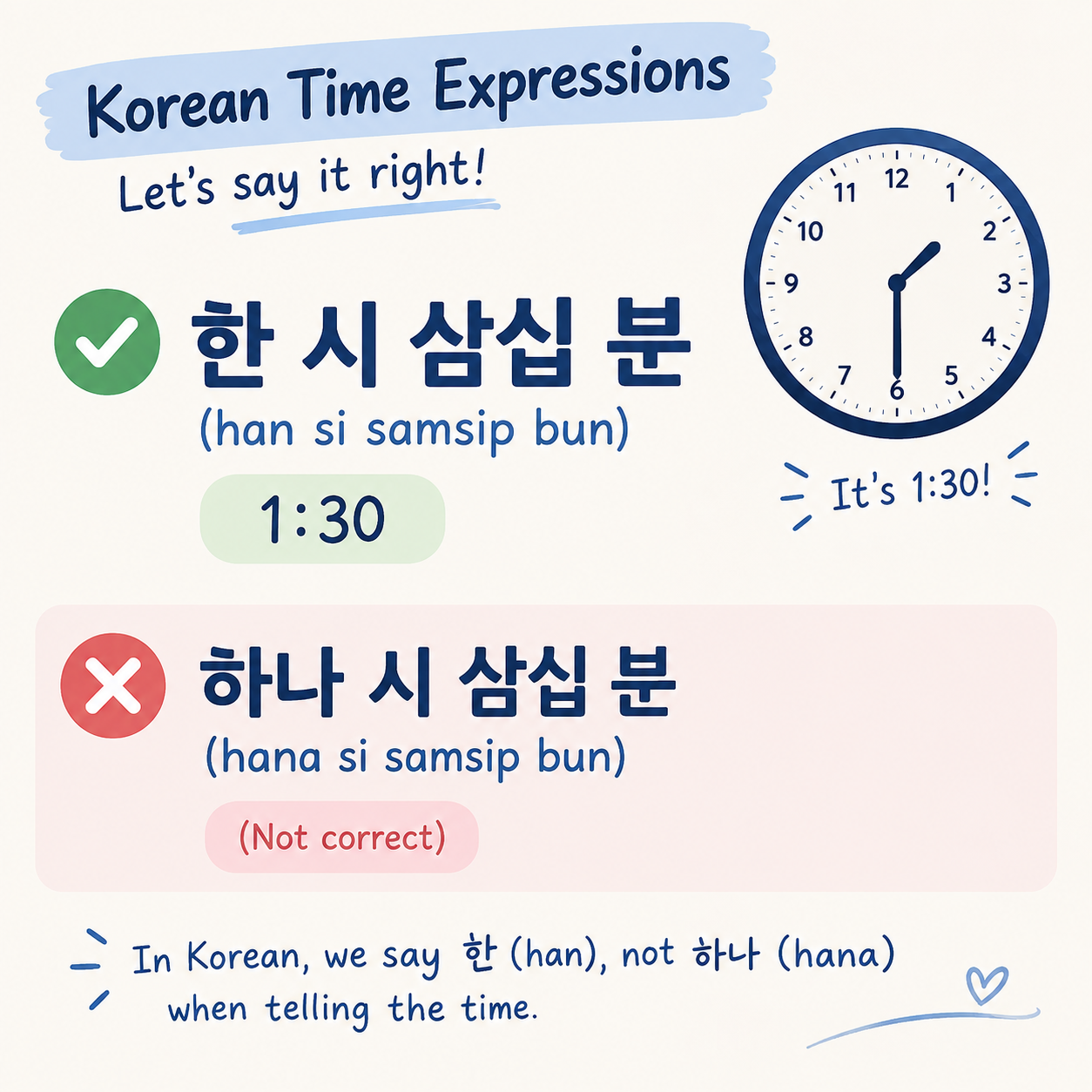
One of the biggest hurdles for beginners learning Korean is the two-number system. Learn how native Korean and Sino-Korean numbers work with time and counting units, including examples like 한 시 삼십 분 (han si samsip bun) and 세 마리 (se mari).
한국어를 배우는 초급자에게 여러 고비들이 있다.
그 중에 하나를 꼽자면 한국어의 숫자는 한 가지가 아니라는 점이다. 고유한 숫자인 하나, 둘, 셋, 넷, 다섯… 등과 같은 것들이 있고, 다른 하나는 중국어에서 온 숫자들이다. 바로 일, 이, 삼, 사, 오… 등이 그것들이다.
뭐 여기까지는 괜찮다. 워낙에 한국어는 오래된 언어라서 고유한 숫자의 이름들이 존재하는 것은 어쩌면 당연한 이야기이다. 그리고 중국과의 교류 또한 오래된지라 중국에서 온 숫자들도 같이 쓰는 것에 큰 불만들이 없을 것이다.
문제는 시간을 이야기할 때이다.
시는 고유한 한국어의 숫자인 하나, 둘, 셋, 넷 등을 쓴다.
분은 중국에서 온 숫자인 일, 이, 삼, 사 등을 쓴다.
한국인으로서 이는 어릴때부터 접한 숫자체계라서 아무런 의문점이 없었는데, 막상 가르치는 입장에서는 백이면 백 모두 고개를 절래절래 흔든다. 같은 숫자체계를 쓰지 않아서 힘든 것이다. 같은 숫자로 읽으면 얼마나 편하겠는가.
게다가 시간을 이야기할 때에 ‘시’와 ‘분’은 단위이고, 이를 숫자와 결합하면 어떨 때에는 원래의 형태가 아닌 조금 다른 형태를 쓴다. 다음을 읽어 보자.
1 : 30
이를 읽자면, ‘한 시 삼십 분’이다. 즉, ‘하나 시 삼십 분’이 아닌 것이다.
단위와 결합할 때에 한국어의 고유한 숫자들은 조금 다른 형태를 나타낸다.
정리하면 다음과 같다.
하나(1) → 한
둘(2) → 두
셋(3) → 세
넷(4) → 네
스물(20) → 스무
그래서 가령 ‘고양이 3마리’를 읽을 때에는 ‘고양이 셋 마리’가 아닌 ‘고양이 세 마리’가 된다. 당신이 만약 20살이면 ‘스무 살’로 말해야 한다. 당신이 만약 23살이면 ‘스물 세 살’로 말해야 한다.
이 고비를 넘기면 된다. 당신은 이미 많이 알고 있다. 설사 시간을 달리 말해도 괜찮다. 시간을 볼 때 생각이 나면 연습하기를 권한다.
There are several hurdles for beginners learning Korean.
One of them is the fact that Korean has not one, but two different number systems.
There are native Korean numbers such as hana, dul, set, net, daseot (one, two, three, four, five…), and there are Sino-Korean numbers that came from Chinese, such as il, i, sam, sa, o (one, two, three, four, five…).
So far, so good.
Korean is a language with a long history, so it is hardly surprising that it has its own native number system. And given the long history of cultural exchange with China, it is also understandable that Sino-Korean numbers became part of the language.
The real problem comes when talking about time.
For the hour, Korean uses native Korean numbers: hana, dul, set, net, and so on.
For the minutes, it uses Sino-Korean numbers: il, i, sam, sa, and so on.
As a Korean, I grew up with this number system, so I never really questioned it. But when I started teaching Korean, I realized just how confusing it can be. Almost every beginner shakes their head when they encounter it.
The problem is simple: you are using two different number systems for the same thing.
Wouldn't it be much easier if we could just use the same numbers?
And there is another little complication.
When native Korean numbers are combined with certain counting units, they sometimes change their form.
For example, look at this:
1:30
In Korean, this is read as:
한 시 삼십 분 (han si samsip bun)
Not:
하나 시 삼십 분 (hana si samsip bun)
When native Korean numbers are used together with counting units, some of them change slightly:
하나 (1) → 한 (han)
둘 (2) → 두 (du)
셋 (3) → 세 (se)
넷 (4) → 네 (ne)
스물 (20) → 스무 (seumu)
So, for example, “three cats” is not:
고양이 셋 마리 (goyangi set mari)
but:
고양이 세 마리 (goyangi se mari)
And if you are 20 years old, you say:
스무 살 (seumu sal)
If you are 23, you say:
스물세 살 (seumul-se sal)
Once you get past this hurdle, you're already well on your way. You probably know much more Korean than you think.
And don't worry if you sometimes say the time incorrectly. That's perfectly fine.
The next time you look at a clock, try reading the time out loud in Korean.
A little practice every time you check the time will gradually make this confusing number system feel much more natural.
‘책이 있어요’는 왜 ‘책을 있어요’가 아닌가 Why Do We Say ‘책이 있어요’ Instead of ‘책을 있어요’?
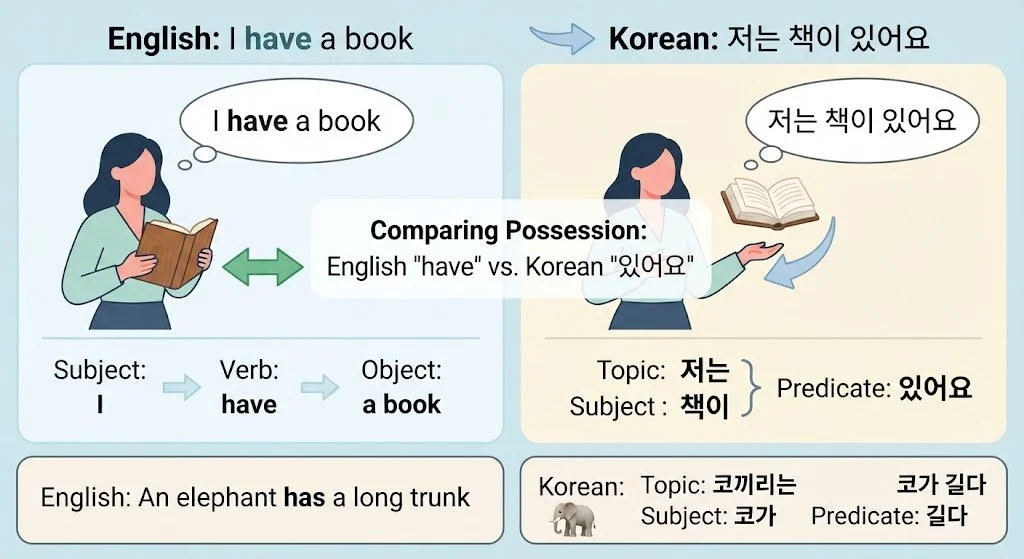
An excerpt from a lesson on the Korean grammatical structure of 있다, and why “I have a book” is expressed as 저는 책이 있어요, rather than 저는 책을 있어요.
“I have a book”을 해석해보자.
저는 책이 있어요.
저는 책을 있어요.
무엇이 맞는가?
답은 첫번째이다. ‘저는 책이 있어요’이다.
영어의 ‘a book’이 동사 ‘have’ 앞에 놓인 목적어이기 때문에, 한국어에서도 ‘책’을 목적어로 생각하기 쉽다. 그런데 어째서 목적격 조사 ‘을,를’이 아닌 주격조사 ‘이, 가’를 붙이는가?
그것은 ‘있어요’가 기본적으로 ‘have’가 아니기 때문이다.
‘있어요’의 원형은 ‘있다’이다. 영어로 하면 ‘exist’에 가깝다. 그러므로 ‘저는 책이 있어요’가 되며, 영어로 자연스럽게 바꾸면 “I have a book”이다. 그러나 한국어의 구조를 이해하기 위해서 직역을 하면 ‘As for me, there is a book’으로 이해하는 것이 좋겠다.
보통 한국어 학습자들이 ‘있어요’를 배울 때, 두 가지 타입으로 받아들인다. 하나는 ‘존재’이며, 다른 하나는 ‘소유’이다. 이는 영어가 백그라운드인 학습자의 배움의 편의에 의해서 나온 분류이다. ‘있어요’의 기본형인 ‘있다’의 기본적인 의미는 ‘존재’이며, 문맥에 따라 소유·위치·상태 등의 의미로 확장되어 나타난다.
그렇다면 ‘저는’은 주어가 아닌가?
즉 “저는 책이 있어요”는,
현대 국어 문법에서는 ‘저는’을 주어라고 보기 보다는,
화제 - 저는
주어 - 책이
라고 본다.
학자에 따라서는 이를 이중 주어문으로 해석을 한다. 즉,
주어 1 - 저는
주어 2 - 책이
라고 해석이 가능하다. ‘저는’과 ‘책이’를 각각 주어로 보는 것이다.
이러한 분석에서는 첫 번째 주어가 두 번째 주어가 나타내는 대상을 소유하거나 그와 관련된 전체를 나타내는 역할을 한다.
다음의 예시를 보자.
“코끼리는 코가 길다”
여기서 ‘길다’와 직접적 서술어의 관계를 맺는 것은 무엇일까?
‘코끼리는’인가? ‘코가’인가?
두번째 성인 ‘코가’가 실질적인 주어이지만, 그 코를 가진 것은 ‘코끼리’이기 때문에 섣불리 말하기가 어렵다. (이에 대해서는 학자들마다 의견이 분분하다.)
역시 현대 한국어 문법을 따라서,
화제 - 코끼리는
주어 - 코가
길다 - 서술어
로 보는 것이 좋겠다.
즉, 영어의 ‘have’는 결국 한국어에서의 ‘있다’와 서로 완전히 다른 문법적 구조를 가진다.
한국어의 모든 문장 성분이 영어의 그것과 정확히 일치하면 한국어 배우기가 훨씬 수월하겠지만, 이렇게 다른 의미 해석이 나오는 경우가 훨씬 더 많다.
Let’s take a look at the sentence, “I have a book.”
저는 책이 있어요.
저는 책을 있어요.
Which one is correct?
The answer is the first one: 저는 책이 있어요.
Because “a book” is the object that comes after the verb “have” in English, it is easy to think of 책 (book) as an object in Korean as well. But why do we use the subject marker 이/가 instead of the object marker 을/를?
The reason is that 있어요 is not basically the Korean equivalent of “have.”
The dictionary form of 있어요 is 있다, which is closer in meaning to the English verb “exist.” Therefore, we say 저는 책이 있어요. If we translate it naturally into English, it becomes “I have a book.” However, in order to understand the Korean sentence structure, it can be helpful to think of a literal translation as:
“As for me, there is a book.”
When Korean learners study 있어요, they often understand it as having two different types of meaning. One is existence, and the other is possession. This distinction is largely made for the convenience of learners whose linguistic background is English.
The basic meaning of 있다, the dictionary form of 있어요, is existence, and depending on the context, it can extend to meanings such as possession, location, and state.
Then what about 저는? Isn’t it the subject?
In modern Korean grammar, rather than treating 저는 as the subject, it is generally analyzed as the topic, while 책이 is the subject:
Topic — 저는
Subject — 책이
Depending on the scholar or grammatical analysis, however, this can also be interpreted as a double-subject construction. In that analysis:
Subject 1 — 저는
Subject 2 — 책이
In other words, both 저는 and 책이 can be analyzed as subjects.
Under this analysis, the first subject represents the whole or the entity that possesses or is associated with what the second subject refers to.
Let’s look at another example:
코끼리는 코가 길다.
“An elephant has a long trunk.”
Here, which element has a direct predicative relationship with 길다 (is long)?
Is it 코끼리는 (as for the elephant)?
Or is it 코가 (the trunk)?
The second element, 코가, is the one that has the direct predicative relationship with 길다, and therefore can be considered the actual subject. However, it is the elephant that possesses the trunk, so the relationship between the two elements cannot be explained quite so simply. (Scholars have different views on how exactly to analyze this structure.)
Again, following the general analysis used in modern Korean grammar, it is useful to understand the sentence as:
Topic — 코끼리는
Subject — 코가
Predicate — 길다
In other words, English “have” and Korean “있다” ultimately express possession through very different grammatical structures.
If every sentence element in Korean corresponded exactly to its counterpart in English, learning Korean would certainly be much easier. But there are many more cases in which the two languages organize and interpret meaning differently in this way.