사주(四柱) 단상 A Reflection on Saju
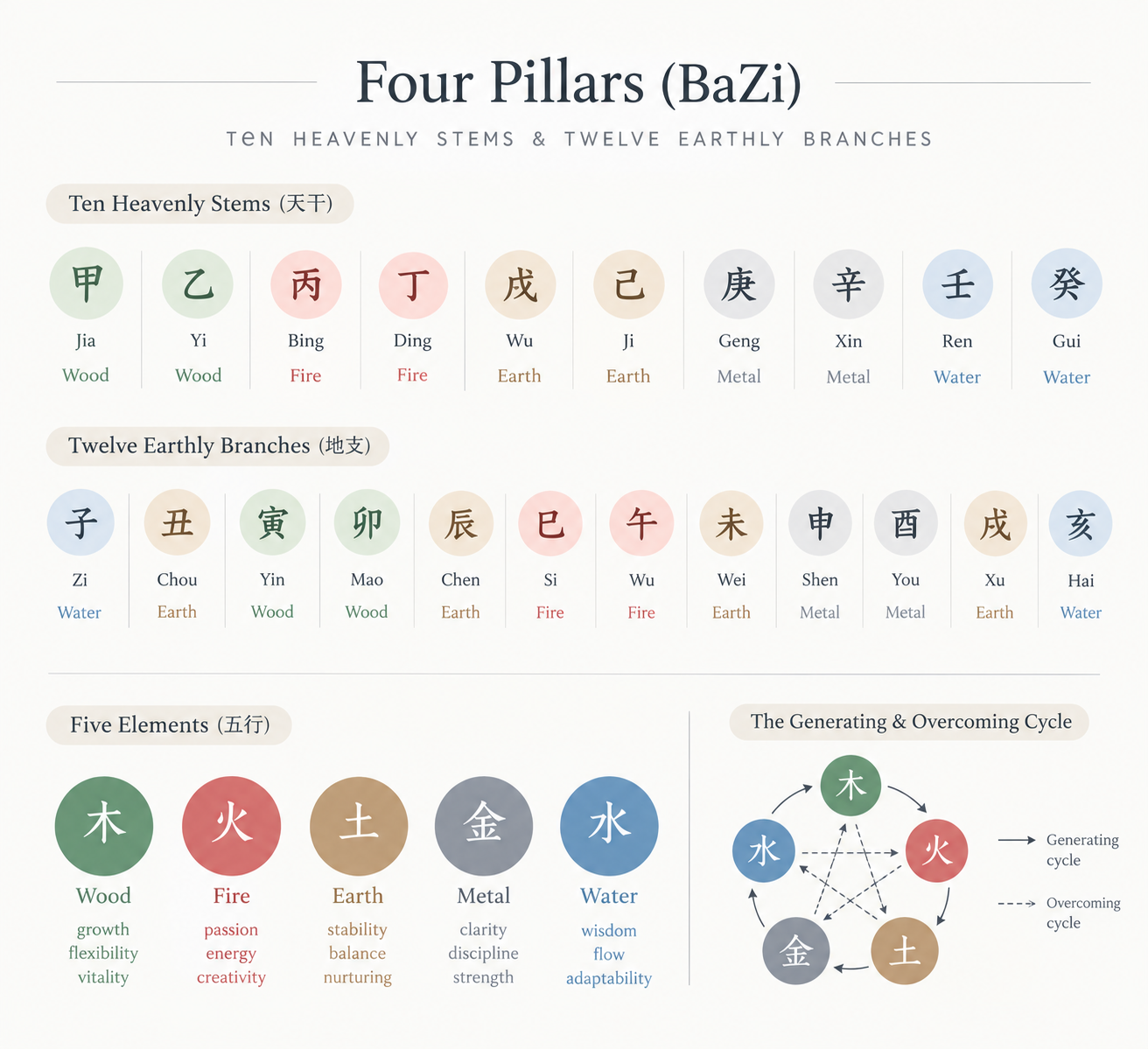
모든 학문은 인간에 대한 학문이다. 학문의 기원은 당연히 인간의 필요에 의해서 만들어졌다. 학문은 더 나은 삶을 영위하기 위해서, 생활의 불편을 해소하기 위해서 만들어졌다. 설령 철학이나 역사와 같이 그 학문이 오늘날에 이르러 실용적이지 않다고 여길지라도, 생각을 하는 인간이기에, 기록을 하는 인간이기에 철학이 만들어졌고 역사가 만들어졌다.
나는 요새 ‘명리학’을 공부하고 있다. 명리학이 무엇인지 사전을 찾아보자면 다음과 같다.
: 반복되는 시간의 패턴을 통한 규칙을 바탕으로 자신이 갖고 태어난 사주를 분석하고 운을 예측하는 학문.
누구나 자신에 대한 궁금증이 있다. 나는 왜 이 세상에 태어나서 이토록 많은 일들을 겪고 사는 것인가. 나는 누구인가. 평생 이 숙제를 안고 죽음을 향해 살아가는 것이다.
사주는 단순하게 ‘네 개의 기둥’을 말한다. 사람의 운명에서 네 개의 기둥은 무엇을 말하는가.
연, 월, 일, 시
연은 내가 태어난 해를 말한다. 월은 내가 태어난 달을 말한다. 일은 내가 태어난 날을 말한다. 시는 내가 태어난 시간을 말한다.
사전적 정의가 ‘사주를 분석하고 운을 예측하는 학문’이 명리학이라지만, 앞날에 대한 예측보다는 적어도 내가 살아온 궤적에 대한 분석만이라도 했으면 해서 이 공부를 시작하게 되었다. 예측이라는 것은 나의 영역이 아니라는 생각 때문이다.
그런데 사람마다 어떤 패턴이 존재하는가? 양자물리학에 ‘불확정성의 원리’라는 게 있다. 즉, 불확정성의 원리는 미시세계에서 어떤 물체의 위치와 운동량을 동시에 정확하게 알아낼 수 없다는 양자역학의 기본 원리이다. 이는 측정 기술의 한계가 아니라 자연의 근본적인 특성으로, 입자가 본질적으로 특정한 위치와 운동량을 동시에 갖지 않음을 의미한다. 물론 두개의 대상이 전제로 되어 있기는 하지만, 이를 인간사에 적용해보면 그래도 그 나름대로의 패턴이 존재한다. 즉 저 네개의 기둥을 가지고 통계를 낼 수 있는 것이다. 특히 태어난 날을 기준으로 보면 좀더 그 사람의 성향을 예측할 수는 있다. 언뜻 보면 그저 네 가지만 알면 되겠지 싶지만, 이것의 해석은 60갑자를 기준으로 하기에 경우의 수가 60분의 1이고, 그외의 환경, 주변인 등등의 변수들을 고려하기는 해야해서 굉장히 복잡한 학문이다.
그래서 섣불리 명리학을 쉽게 바라보아서는 안된다. 특히 타인의 사주에 대한 풀이를 해줄 때에 실수를 범하고, 상처를 줄 수 있다. 30년, 40년씩 아니 평생동안 이 공부를 하는 사람들도 많다. 그리고 이 학문의 끝은 없다. 인간사가 계속되는 한, 명리학은 계속 존재할 것이고, 자연과 우주의 순환 앞에서 겸손한 자세를 유지하면서 공부해야 한다.
A Reflection on Saju
All academic disciplines, in one way or another, are ultimately studies of human beings.
The origins of knowledge and scholarship naturally lie in human needs. Academic disciplines developed in order to help us lead better lives and to resolve the inconveniences we encounter in everyday life. Even if disciplines such as philosophy or history may seem less practical in the modern world, philosophy emerged because human beings think, and history emerged because human beings record.
These days, I have been studying Myeongrihak (명리학), the traditional Korean study of destiny and the patterns of time.
If we look up the definition of Myeongrihak in a dictionary, it can be described as:
A discipline that analyzes the saju one is born with and predicts one's fortune based on rules derived from recurring patterns of time.
Everyone has questions about themselves.
Why was I born into this world, only to experience so many things throughout my life? Who am I?
We live our entire lives carrying these questions with us, moving inevitably toward death.
Saju (四柱) literally means “four pillars.” But what do these four pillars represent in relation to a person's destiny?
They are year, month, day, and time.
The year refers to the year in which I was born.
The month refers to the month in which I was born.
The day refers to the day on which I was born.
And the time refers to the time at which I was born.
Although the dictionary defines Myeongrihak as a discipline that analyzes saju and predicts one's future, I began studying it not so much to predict what lies ahead, but simply to understand and analyze the trajectory of the life I have already lived.
I believe that prediction belongs to a realm beyond my own.
But does every person really have some kind of pattern?
In quantum physics, there is something known as the uncertainty principle. In other words, the uncertainty principle is a fundamental principle of quantum mechanics stating that, at the microscopic level, the position and momentum of an object cannot both be known with complete precision at the same time.
This is not merely a limitation of measurement technology. Rather, it reflects a fundamental characteristic of nature: a particle does not inherently possess a precisely determined position and momentum simultaneously.
Of course, the principle concerns two properties of an object. But if we apply the idea, in a broader sense, to human affairs, perhaps we can still say that certain patterns exist.
In other words, it is possible to gather statistics based on those four pillars.
In particular, when the day of birth is taken as a reference point, it may be possible to identify or anticipate certain tendencies in a person.
At first glance, one might think that all we need are those four pieces of information. But interpreting them is far from simple. The system is based on the 60 combinations of the traditional sexagenary cycle(the traditional 60-cycle system of the Chinese calendar), and there are countless other variables to consider—one's environment, the people around them, their circumstances, and so on.
It is, therefore, an extraordinarily complex field of study.
That is why Myeongrihak should not be approached too casually or simplistically.
This is especially important when interpreting someone else's saju. A careless interpretation can lead to mistakes and, more seriously, can cause another person pain.
There are many people who study this subject for thirty or forty years—or even for their entire lives.
And there is no final destination in this field of study.
As long as human life continues, Myeongrihak will continue to exist. And as we study it, we should maintain a humble attitude before the cycles of nature and the universe.
Perhaps that humility is the most important lesson of all.